
Real-Time Analytics for Multilingual Museum Visitors

Real-Time Analytics for Multilingual Museum Visitors
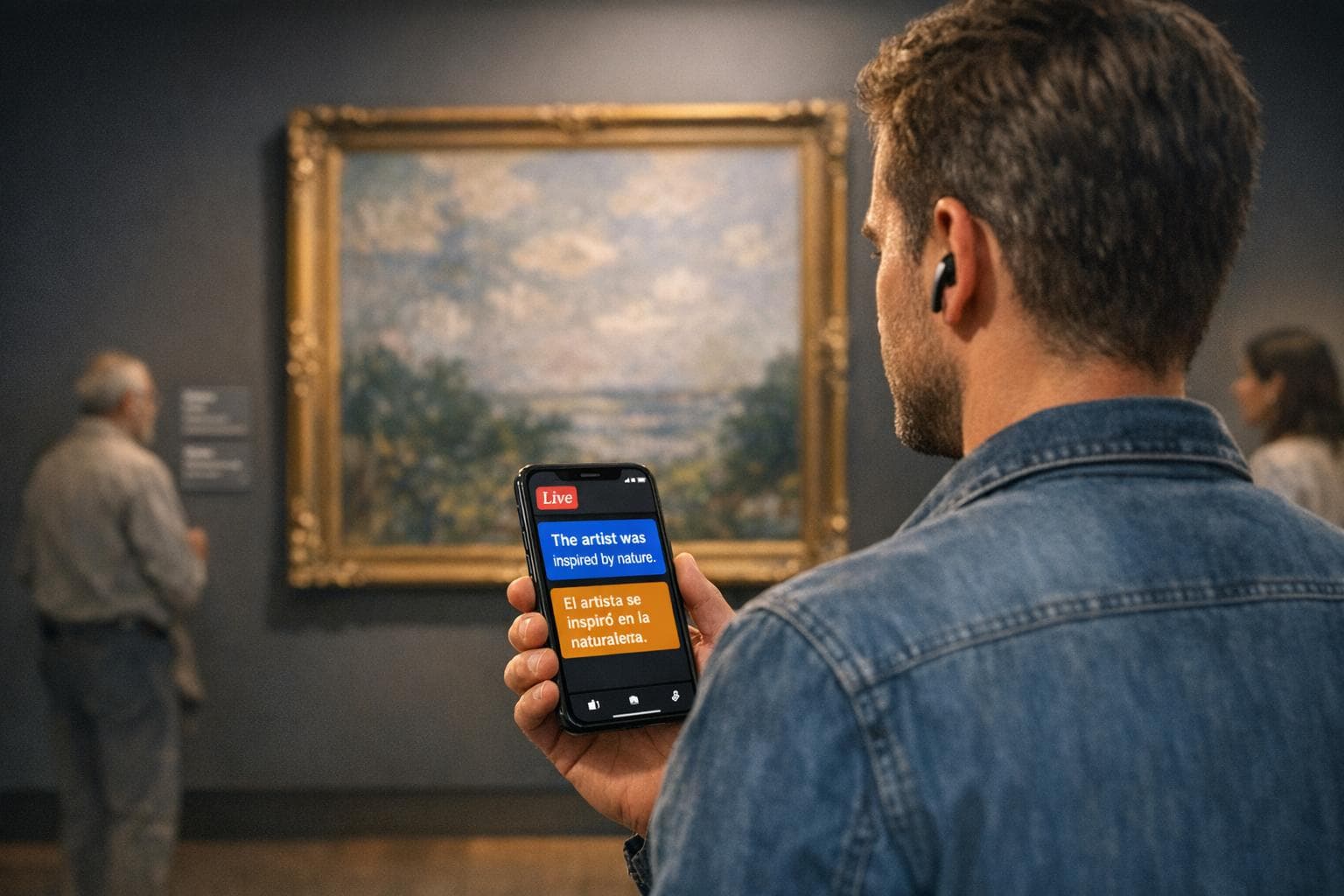
Museums are transforming visitor experiences with real-time analytics and AI tools. By collecting and processing data instantly - like visitor movement, language preferences, and exhibit interactions - museums can provide personalized content in multiple languages. This technology addresses language barriers, improves engagement, and enhances overall satisfaction.
Key takeaways:
- Real-Time Data: Tracks visitor behavior (e.g., time spent, movement patterns) to adjust exhibits and resources instantly.
- AI Translation Tools: Apps like Museumfy and ExhibitXplorer offer instant multilingual translations for exhibit details and guided tours.
- Improved Engagement: Tools like the ArtLens app increased average viewing time per object from 2–3 seconds to 15 seconds.
- Operational Efficiency: Museums like the Art Institute of Chicago used analytics to generate $2M+ in additional revenue.
- Privacy Focus: Data collection is anonymized to comply with regulations like GDPR.
Temi Tour Guide for Museums and Galleries: Revolutionising Visitor Experiences
What Real-Time Analytics Means for Museums
Real-Time vs Post-Visit Museum Analytics Comparison
Real-time analytics in museums involves the instant gathering, processing, and visualization of visitor data - like movement patterns, time spent in specific areas, and digital interactions. This allows museums to make quick decisions and adapt experiences on the fly. Unlike traditional methods that analyze data after the fact, real-time systems process information as it happens. This enables museums to respond to visitor needs in seconds, improving both operations and the overall visitor journey.
This technology has a dual impact. Operationally, staff can adjust to crowd surges by reallocating resources or modifying environmental controls, such as lighting and temperature, based on current conditions. On the visitor side, real-time data enhances the experience by offering tailored content through location-triggered notifications and interactive features. For example, smart badges can connect visitors with similar interests, encouraging dynamic group interactions.
How does this work? Sensors like BLE beacons, Wi-Fi, and stereo cameras track visitor behavior. AI-powered dashboards then transform this data into heat maps and visuals that are easy for staff to understand and act on. Privacy concerns are addressed through anonymized data collection methods, which are explained later in this article.
How Real-Time Analytics Works
Museums use a combination of hardware sensors and AI software to track visitor activity. BLE beacons monitor precise locations as visitors move through galleries, while Wi-Fi tracking provides broader insights into dwell times across larger areas. Stereo cameras add another layer by capturing movement patterns without identifying individual faces.
One example is the Art Institute of Chicago, which implemented a real-time dashboard from 2014 to 2017. After being ranked "#1 Museum in the World" by TripAdvisor, the museum used the dashboard to monitor attendance patterns and adjust marketing strategies in real time. This resulted in over $2 million in additional net revenue from admissions. By analyzing aggregated Wi-Fi signals, they created heat maps to visualize visitor density and time spent in different galleries. Andrew Simnick, the museum's Senior Vice President for Finance, Strategy, and Operations, highlighted the importance of timely decision-making:
"Delays due to perfectionism can erode the value from investments in analytics, and additional work only matters when it can impact a decision. To make progress, we strive for the 'good enough' answer where appropriate".
To address privacy concerns, modern tracking systems use anonymized data collection methods that comply with regulations like GDPR. For example, stereo cameras capture visitor movement without storing facial images, and Wi-Fi tracking aggregates data without identifying individual devices.
Real-Time vs. Post-Visit Analytics
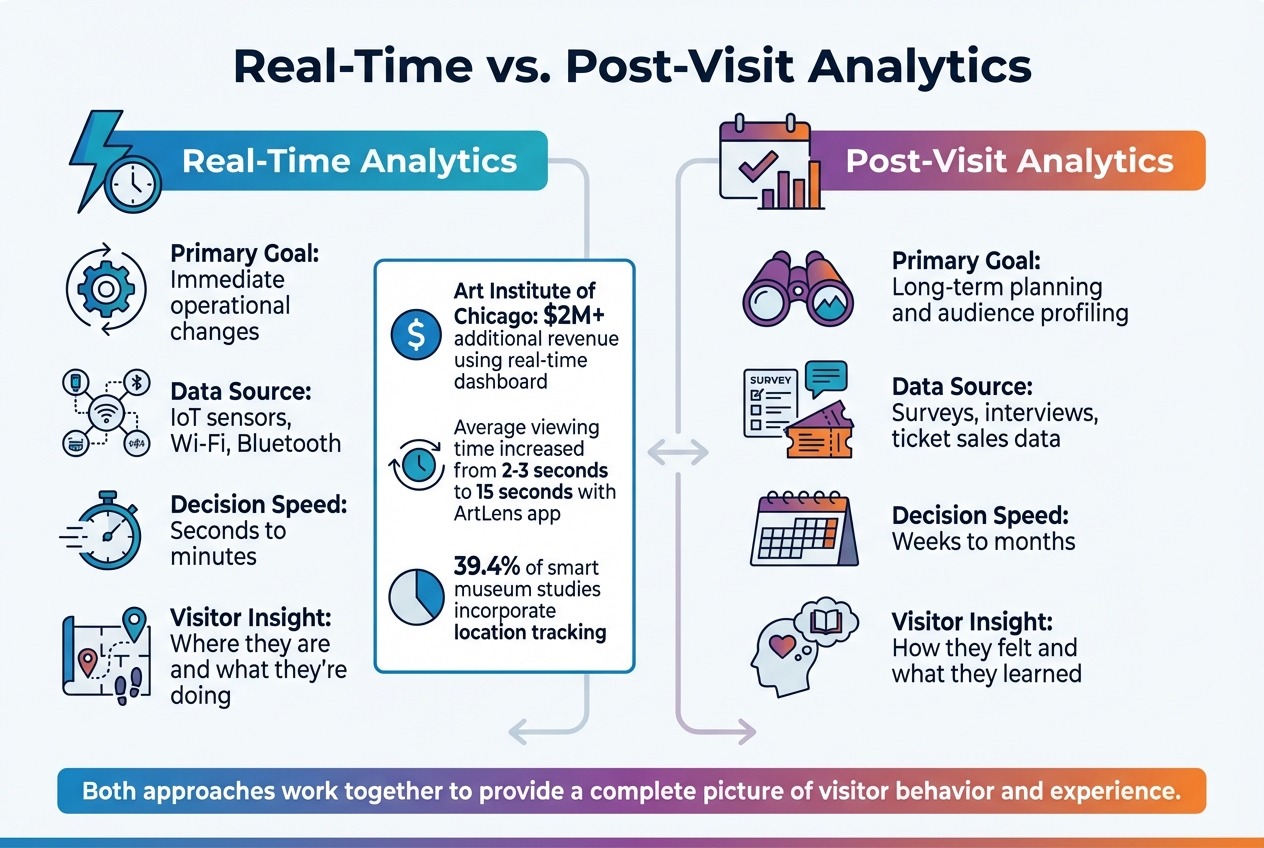
The key difference between real-time and post-visit analytics lies in timing. Real-time analytics enables immediate actions, like opening or closing galleries during peak times, sending location-based alerts to visitors, or adjusting marketing efforts based on live attendance data. On the other hand, post-visit analytics focuses on long-term planning, such as identifying seasonal trends, improving exhibition schedules, and evaluating past campaigns.
| Feature | Real-Time Analytics | Post-Visit Analytics |
|---|---|---|
| Primary Goal | Immediate operational changes | Long-term planning and audience profiling |
| Data Source | IoT sensors, Wi-Fi, Bluetooth | Surveys, interviews, ticket sales data |
| Decision Speed | Seconds to minutes | Weeks to months |
| Visitor Insight | Where they are and what they’re doing | How they felt and what they learned |
Real-time insights allow museums to act quickly during a visitor's experience, while post-visit analysis provides deeper understanding for future improvements. For example, the Metropolitan Museum of Art uses a centralized dashboard powered by Google Analytics to monitor live traffic. This helps the digital media team respond to trends - like spikes in traffic from viral social media posts - and allocate resources accordingly. Elena Villaespesa, the Met’s Digital Media Analyst, explained:
"The main objective of having a dashboard is to communicate the impact of our digital initiatives and to be able to make decisions in an effective and rapid way".
Both approaches work together to provide a complete picture. Real-time data reveals objective behavior - where visitors go and how long they stay - while post-visit surveys uncover emotional and cognitive responses to the experience. For instance, the Strong Museum of Play used a beacon-free analytics solution between 2024 and 2025 to identify crowd hotspots in real time. This allowed them to optimize staff placement and exhibit layouts, leading to reduced maintenance costs and higher visitor satisfaction scores.
Solving Language Barriers with AI Tools
Museums are turning to advanced AI solutions to tackle the challenge of language barriers, which often limit international visitors' ability to fully engage with exhibits. While most museums provide exhibit information in only 6–9 languages, this leaves a significant portion of visitors unable to access detailed artifact descriptions or participate in guided tours effectively. For example, at the Metropolitan Museum of Art, 90% of English-speaking visitors rated their guide experience as "good" or "very good", but this number drops to 73% for non-English speakers, who often receive only basic information. Without access to their native language, visitors can miss out on historical context, guided narratives, and the ability to ask questions, making their experience less immersive. Traditional audio guides, which rely on rental hardware and pre-recorded content, further limit flexibility and fail to adapt to individual learning needs.
AI-Powered Multilingual Tools in Museums
To address these issues, museums are embracing AI-powered tools that deliver real-time, dynamic translations. Technologies like Neural Machine Translation and speech recognition now make it possible to instantly translate exhibit labels, guided tours, and even conversations with staff. Instead of relying on cumbersome rental hardware, many museums are adopting web-based solutions that visitors can use directly on their smartphones. These tools often include features like voice-assisted search and visual recognition, enhancing accessibility and convenience.
One standout example is Museumfy, a platform that allows visitors to take a photo of an artifact or artwork and instantly receive detailed insights and historical context in over 20 languages. The app offers both text and audio explanations, tailoring the experience to individual interests - whether it's an academic looking for provenance details or a student seeking an engaging story. At $9.99 per month for unlimited access, Museumfy eliminates the need for traditional hardware rentals while providing a premium experience. Joshua Viner, a travel and technology expert, highlights the impact of such tools:
"The ability to understand exhibits, artifacts, and artworks in one's native language, regardless of the country or museum, is a game-changer for global tourism and cultural exchange".
Other advanced systems, like ExhibitXplorer, use contextual geofencing to deliver personalized content as visitors approach specific exhibits. This automated approach ensures that relevant information is presented instantly in the visitor's preferred language. A notable example is The Louvre's partnership with TravelAI, which resulted in a mobile app offering real-time translations for exhibit details and guided tours in over 30 languages. These innovations demonstrate how AI-driven tools are breaking down language barriers, creating a more inclusive and engaging museum experience for visitors worldwide.
Personalizing Experiences with Visitor Flow Data
Museums are taking real-time visitor analytics to the next level by using flow data to create experiences tailored to individual preferences and language needs. By monitoring how visitors navigate exhibits and which displays hold their attention, institutions can offer personalized recommendations that make visits more engaging and welcoming - especially for multilingual audiences. This approach doesn't just highlight traffic patterns; it directly shapes strategies for delivering language-specific content.
Tracking Visitor Movement and Behavior
To understand visitor behavior, museums rely on tools like BLE beacons, Wi-Fi analytics, and RFID cards. These technologies track visitor locations, time spent at exhibits, and their paths through galleries. Such insights help museums address congestion, identify underused spaces, and better cater to visitor interests.
Take the Galleria Borghese in Rome, for example. Between June and August 2019, the museum rolled out an IoT-based tracking system with 14 Raspberry Pi receivers and BLE beacons. Data from 900 visitors resulted in 1,308,617 records, mapping out how people moved through the museum. This revealed bottlenecks in areas like the Caravaggio room, allowing curators to optimize ticketing and manage entry flows.
Similarly, in July 2017, the British Museum teamed up with Microsoft to analyze visitor behavior using data from Wi-Fi hotspots and audio guides. Siorna Ashby, Senior Project Manager, and her team used Azure and Power BI to uncover surprising patterns:
"We assumed it was the Rosetta Stone on the ground floor, but we also saw people start on the second and third floor. Power BI made this very visual for us."
This discovery led the museum to place multilingual information at actual starting points chosen by visitors, rather than relying solely on staff predictions. A broader review found that 39.4% of smart museum studies now incorporate location tracking systems, with 72.7% focusing on movement patterns and interactive engagement.
These insights are paving the way for real-time, personalized visitor experiences.
Providing Personalized Recommendations
Visitor flow data isn't just about understanding movement - it's about enhancing experiences in real time. For example, if sensors detect crowding at a popular exhibit, the system can notify visitors in their native language and suggest quieter, interest-aligned alternatives. This reduces frustration and helps visitors discover lesser-known exhibits they might otherwise overlook.
Platforms like Museumfy take personalization even further. Visitors can photograph any artwork and receive tailored insights in over 20 languages. The system adapts based on user behavior - for instance, if someone spends extra time reading detailed historical context, the platform offers deeper analysis for other works they encounter.
The traveling exhibition "Heart over Heels" used RFID technology to track 27,779 visitors at its Dortmund venue. By analyzing which interactive exhibits each person engaged with, the system delivered personalized digital content tied to their interests. This created a unique, memorable experience for every visitor, extending the connection beyond the museum walls.
Research underscores the power of personalization: using beacons to send context-specific messages at key moments can boost transaction intent by up to 20 times. The Strong Museum of Play implemented Mapsted's beacon-free location analytics to create real-time heat maps of visitor activity. This allowed the museum to adjust staff placement and improve exhibit navigation.
For multilingual guests, the system automatically provides audio explanations in their preferred language and suggests related exhibits. For example, if a visitor spends extra time exploring Renaissance art, the platform might recommend upcoming gallery talks or workshops on the topic - all communicated in their chosen language. This level of personalization ensures that international visitors feel welcomed and fully immersed in the museum's offerings.
sbb-itb-e44833b
Measuring the Impact of Real-Time Multilingual Analytics
Museums leveraging real-time multilingual analytics are seeing tangible improvements in visitor satisfaction, operational efficiency, and revenue generation. The integration of language-inclusive technology is reshaping how museums engage with their audiences and refine their business strategies.
Better Visitor Satisfaction and Engagement
Real-time analytics provides concrete insights into how multilingual tools influence visitor behavior. For instance, the Cleveland Museum of Art’s ArtLens app boosted the average viewing time per object from just 2–3 seconds to an impressive 15 seconds. Similarly, a July 2017 collaboration between the British Museum and Microsoft revealed a strong link between mobile app usage and overall visitor satisfaction, with a correlation coefficient of r = 0.71 (p < 0.001). Siorna Ashby, Senior Project Manager, emphasized the museum’s data-driven approach:
"Whenever the museum makes a decision, whether that's extending opening hours or improving audio guides, the Big Data team wants to look to the data first."
At the Smithsonian National Museum of Natural History, visitors using the "Skin & Bones" app spent significantly more time in exhibit halls, far exceeding the baseline average of 3 minutes and 24 seconds. Meanwhile, at the Cooper Hewitt Design Museum, 30% of visitors accessed their personal digital collections after their visit, extending their engagement beyond the physical museum space.
These improved visitor experiences not only enhance satisfaction but also contribute to meaningful operational and financial outcomes.
Operational and Financial Benefits
Enhanced visitor engagement often leads to measurable financial rewards. Data-driven organizations are statistically 19 times more likely to be profitable, 23 times more likely to attract new customers, and 6 times more likely to retain existing ones.
The Art Institute of Chicago exemplifies this potential, using a business intelligence dashboard to refine marketing strategies. This approach helped the museum generate over $2 million in additional net revenue from admissions after earning a "#1 Museum in the World" ranking on TripAdvisor.
Digital tools also help cut operational costs. For example, the Metropolitan Museum of Art replaced 3.5 million printed maps with digital wayfinding solutions, significantly reducing expenses. Dale Hedding, Vice President of Development at the Chicago Symphony Orchestra Association, highlighted the broader benefits of analytics:
"Much more extensive use of data analytics tools and directional-trending analysis is allowing leadership to be proactive in creating revenue streams, serving audiences, understanding the impact of our programs, and making informed pricing decisions."
The Victoria & Albert Museum streamlined its editorial publishing process, achieving an 8x increase in efficiency by adopting a data-integrated content management system. In India, the National Gallery of Modern Art (NGMA) optimized operations across its Delhi, Bengaluru, and Mumbai campuses using a single app interface. This app, which offers multilingual support and audio guides, served over 12,000 active users in 2024 alone.
Real-time analytics also supports predictive maintenance, helping museums minimize equipment downtime and repair costs. Additionally, museums can use data to identify high-traffic exhibits, allowing them to allocate staff more effectively during busy times and ensure a smooth visitor experience.
How to Implement Real-Time Analytics
Choosing the Right Technology
To get a complete picture of visitor behavior, museums should combine data from various sources like website analytics, social media engagement, ticketing systems, and in-gallery interactives. The good news? You don’t need a massive investment - just 15 key data points can provide insights tied to six strategic priorities.
When it comes to tracking technology, museums can choose between hardware-based solutions (like RFID tags, Bluetooth beacons, or Wi-Fi sensors) and hardware-free location analytics. This decision is especially crucial given the financial realities: only 10% of museums in the U.S. operate with budgets over $15 million, while nearly half have budgets between $500,000 and $2.9 million.
For institutions dealing with multilingual audiences, automated translation tools such as Google Translate or DeepL can be integrated into the analytics platform. These tools help process visitor feedback in multiple languages. For instance, in 2025, researchers reviewed 5,856 multilingual Google reviews from 59 top-ranked museums using a guided Latent Dirichlet Allocation (LDA) model, uncovering 12 key topics that informed operational improvements.
These technology choices lay the groundwork for implementing strong privacy safeguards to protect visitor data.
Protecting Privacy and Meeting Regulations
Privacy should be a top priority when gathering visitor data. This means anonymizing information by removing personally identifiable details and securing storage with fingerprint protection and encrypted geolocation tracking. To comply with regulations like GDPR, museums must adopt a consent-based approach, ensuring visitors clearly understand how their data will be used.
Elena Villaespesa, a Digital Media Analyst at the Metropolitan Museum of Art, underscores the importance of transparency:
"One of the keys to establishing a data-driven culture within an organization is to report the results internally."
Using aggregated Wi-Fi signals can reveal traffic patterns without compromising individual privacy. This is especially relevant as statistical and data analysis appear in 97% of recent studies on smart museum methodologies.
Training Staff and Rolling Out Gradually
Once the technology and privacy measures are in place, the next step is preparing the staff to make the most of these analytics. Building data literacy across all levels of the organization is critical, especially since 89% of membership professionals surveyed in 2022 expressed a strong interest in using more data and analytics in their work. Training should also cover multilingual tools and interfaces to cater to diverse visitor groups.
A phased rollout using a "Three Horizons" approach is highly recommended. Start by appointing a senior leader to oversee the process and create a basic dashboard with 10–12 existing data points. Then, work on standardizing data collection methods and addressing any gaps in audience data. Finally, introduce AI-powered predictive modeling and commit to sharing standardized data across the organization.
Front-of-house staff also play a crucial role. They need to be trained on visitor-facing technologies to avoid delays or confusion that could negatively impact the visitor experience.
"Building an effective data collection and analysis program is always challenging. It is even more challenging when you are working in a field that historically has a lack of experience with the power of data."
Pilot programs and staff mock-ups can be a great way to test and refine the system before a full-scale rollout. Automating reports to create easy-to-use dashboards for various departments will further streamline the process. This step-by-step approach helps museums build confidence and expertise without overwhelming their teams or visitors.
Conclusion
Real-time analytics has revolutionized how museums engage with their audiences, turning static exhibits into dynamic, interactive experiences that welcome visitors from all over the globe. By examining visitor behaviors - like movement patterns, time spent at exhibits, and interactions - museums can now offer tailored content that aligns with individual interests and even accommodates different languages. For multilingual visitors, who have often faced challenges due to language barriers, this shift is especially transformative.
The results speak volumes. Personalized experiences powered by AI have increased visitor satisfaction by as much as 40%, and more than 80% of museum leaders now view AI as indispensable for the future of their institutions. Tools like Museumfy, which provides instant multilingual explanations, highlight just how far accessibility has come in a short time.
Beyond enhancing the visitor experience, this data-driven approach also improves operational efficiency. Elena Villaespesa from The Metropolitan Museum of Art emphasizes this dual benefit:
"The main objective of having a dashboard is to communicate the impact of our digital initiatives and to be able to make decisions in an effective and rapid way".
But the benefits go even further. By breaking down language barriers and tailoring content to various learning levels, museums create inclusive spaces where everyone - whether a curious child, a seasoned researcher, a local resident, or an international tourist - can engage with cultural heritage in a way that feels personal and meaningful. Privacy protections and personalized recommendations ensure that this inclusivity doesn’t come at the cost of security.
The message is clear: museums must act swiftly. Embracing real-time multilingual analytics isn’t just about meeting visitor expectations - it’s about redefining what accessibility and engagement mean in the 21st century. Institutions that adopt these tools are not only keeping up with the times but also setting the standard for what cultural spaces can achieve. The real challenge now is how fast museums can implement these strategies to serve their diverse and ever-evolving audiences.
FAQs
How does real-time analytics enhance museum visits for multilingual audiences?
Real-time analytics is reshaping how museums operate, offering instant insights into how visitors interact with exhibits, their preferences, and even their movement throughout the space. With this information, museums can fine-tune exhibit layouts, improve crowd management, and create an environment that feels safer and more enjoyable for everyone. By keeping a close eye on visitor engagement as it happens, museums can also adjust staffing levels and prevent overcrowding, making the entire experience smoother and more pleasant.
For multilingual visitors, real-time data takes accessibility to the next level by enabling customized, inclusive experiences. AI-powered tools can deliver on-the-spot audio guides or text explanations in various languages, breaking down communication barriers and ensuring everyone can connect with the exhibits. These technologies allow museums to respond to visitor needs in real time, offering experiences that are both engaging and meaningful for a diverse audience.
How is visitor privacy protected when collecting data for real-time analytics?
Museums take visitor privacy seriously, employing tools and strategies that limit data collection while prioritizing confidentiality. Instead of gathering personal details, many museums focus on anonymized data, which looks at overall visitor behavior rather than individual tracking. Technologies like cookies and analytics tools are carefully configured to follow strict privacy laws, such as GDPR, ensuring user information stays protected.
Platforms powered by AI, such as Museumfy, take privacy a step further by delivering personalized experiences without resorting to invasive data practices. They rely on secure methods like encryption, opt-in options, and strict adherence to privacy regulations. This approach not only keeps visitor data safe but also allows for multilingual, inclusive, and customized interactions that enhance the museum experience.
How do AI-powered tools make museums more accessible for multilingual visitors?
AI-powered tools are transforming museums into more welcoming spaces by bridging language gaps and tailoring the visitor experience. With real-time translations, visitors can access exhibit descriptions, guided tours, and educational materials in their native language. This not only makes the content easier to understand but also helps visitors form a stronger connection with the art and history being showcased.
Another exciting feature is photo-based translations, where visitors can snap a picture of an exhibit and instantly receive detailed insights in their preferred language. On top of that, multilingual audio guides bring exhibits to life with engaging storytelling in various languages. These tools ensure that museums are accessible to a wide range of visitors, including those who may not speak English fluently or have specific accessibility needs. The result? A more inclusive and enriching experience for all.