
Interactive Art Challenges: How AI Enhances Engagement


Interactive Art Challenges: How AI Enhances Engagement
Museums are transforming how people connect with art through interactive art challenges powered by AI. These challenges turn passive visits into engaging experiences by combining technology, play, and storytelling. Here’s what’s happening:
- Interactive Activities: Visitors can mimic poses, facial expressions, or even participate in augmented reality games like "The Temple of Invention" launched by the Smithsonian American Art Museum in December 2025.
- AI Personalization: Systems like IBM Watson enable real-time Q&A about artworks, while tools like Smartify offer tailored tours based on interests, time, or accessibility needs.
- Gamification: AI introduces scavenger hunts, rewards, and AI-driven characters to guide visitors, making learning more engaging.
- Accessibility: Features like real-time translation and auditory descriptions ensure everyone, including international and visually impaired visitors, can participate.
Museums are also using AI for behind-the-scenes tasks, like analyzing collections or creating digital archives. Tools like Museumfy enhance visits with photo recognition, multilingual support, and personalized insights for as low as $9.99/month. AI isn’t just improving engagement - it’s reshaping how museums operate and connect with audiences.
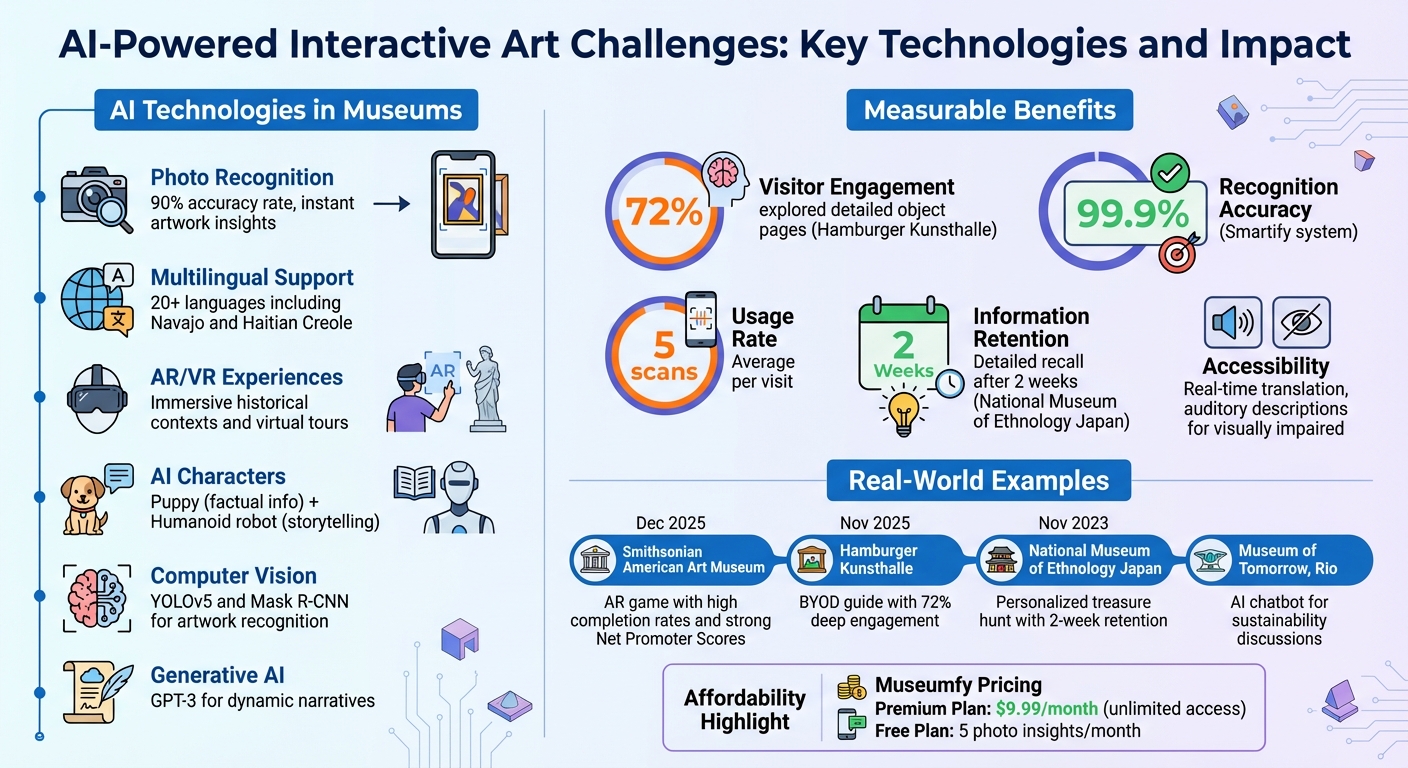
AI Technologies Transforming Museum Experiences: Features and Benefits
The Living Museum: How AI Can Transform the Museum Experience - MuseumNext (July 15, 2025)
sbb-itb-e44833b
How AI Adds Game Elements to Art Experiences
AI is reshaping museum visits, turning them from passive strolls into interactive adventures. By weaving in challenges, rewards, and engaging storytelling, AI transforms traditional exhibits into immersive, game-like experiences. This evolution helps museums stay relevant in a world filled with digital entertainment while keeping the spotlight on their artistic and historical treasures.
Game Elements in Museum Visits
AI brings gaming mechanics right into the heart of museum spaces. Personalized tours are a standout example. These tours adapt to a visitor’s preferences, available time, and accessibility needs, replacing the outdated "one-size-fits-all" model. Through Natural Language Processing, museums can create narratives that link exhibits together into scavenger hunt-style adventures, making the experience feel like chapters in a larger story. These dynamic narratives encourage deeper engagement and exploration.
Another innovation is the use of AI-driven characters to guide visitors. In a study presented at the ArtsIT Conference in 2022/2023, researchers tested a prototype featuring two AI characters: a puppy that shared factual information and a humanoid robot that told fictional stories. Visitors found these AI-guided challenges far more engaging, as they combined education with entertainment. This approach not only sparks curiosity but also helps visitors differentiate between historical facts and creative storytelling.
Examples of AI-Driven Art Challenges
Several real-world examples highlight how AI can elevate museum experiences. For instance, the National Museum of Ethnology in Japan launched a personalized treasure hunt game in November 2023. This system analyzed data from museum guide apps to create custom quizzes. Visitors received AI-generated hints and used exhibit IDs to complete challenges and earn in-game rewards. The results? Visitors retained detailed information about exhibits even two weeks after their visit.
The technology powering these experiences is just as fascinating. Tools like YOLOv5 and Mask R-CNN use computer vision to help mobile apps recognize artworks and trigger location-based challenges. Generative AI models, such as GPT-3, craft dynamic narratives, while translation APIs like DeepL ensure content is accessible to international audiences. Randy Griffey, Head Curator at the Smithsonian American Art Museum, summed up this approach perfectly:
"It begins with looking at the curatorial content and expertise available and then exploring ways for that content to resonate better with a visitor"
.
Benefits of AI-Powered Art Challenges
AI is reshaping traditional museum visits, turning them into interactive, tailored experiences. By incorporating AI-powered art challenges, museums are seeing measurable boosts in visitor engagement, learning outcomes, and accessibility - often outperforming traditional exhibits through smart, data-driven strategies.
Increased Visitor Engagement
Museums are reporting impressive engagement levels thanks to AI-driven initiatives. For instance, the Smithsonian American Art Museum’s augmented reality (AR) game in December 2025 surpassed expectations, achieving strong participation, high completion rates, and outstanding Net Promoter Scores.
Similarly, the Hamburger Kunsthalle introduced an AI-powered "Bring Your Own Device" guide in November 2025, which captivated visitors. Seventy-two percent of attendees explored detailed object pages to dive deeper into the artworks, while the AI scanning tool was used an average of five times per visit. Even more impressive, the system boasted a 99.9% recognition accuracy. These tools not only enhance visitor interaction but also pave the way for more meaningful educational experiences.
Better Learning Outcomes
Deeper engagement naturally leads to better learning. AI transforms passive observation into active discovery by delivering personalized educational content. For example, at Rio de Janeiro’s Museum of Tomorrow, an AI chatbot engages visitors in discussions about sustainability, tailoring conversations to their daily habits and making the information more relatable.
The Hamburger Kunsthalle’s use of Smartify further demonstrates how autonomous exploration can enrich the visitor experience. Prof. Dr. Alexander Klar, the museum’s director, noted:
"Smartify allows us to individualize the visitor experience. People choose what they want to see, and this idea of making our guests more autonomous from any narratives that may be pre-existent is a great thing." - Prof. Dr. Alexander Klar, Director, Hamburger Kunsthalle
By enabling visitors to explore thematic and stylistic connections across thousands of works, AI opens up new ways of understanding art. Machine learning and image recognition uncover links that static displays might miss, while real-time Q&A systems let visitors dive into artistic techniques and historical details.
Accessibility for All Audiences
AI is also breaking down barriers that have historically excluded certain audiences. Translation tools powered by AI are making museum content available in a wider range of languages, including indigenous languages like Navajo and community languages such as Haitian Creole.
For visually impaired visitors, AI-driven auditory descriptions bring art challenges to life in ways that were previously impossible. Platforms like Museumfy enhance accessibility further by offering personalized insights in over 20 languages, delivered through both text and audio. This inclusive approach ensures that international visitors and non-native English speakers can fully participate, transforming museums into spaces where everyone can connect with art on an equal level.
How Museumfy Transforms Art Engagement
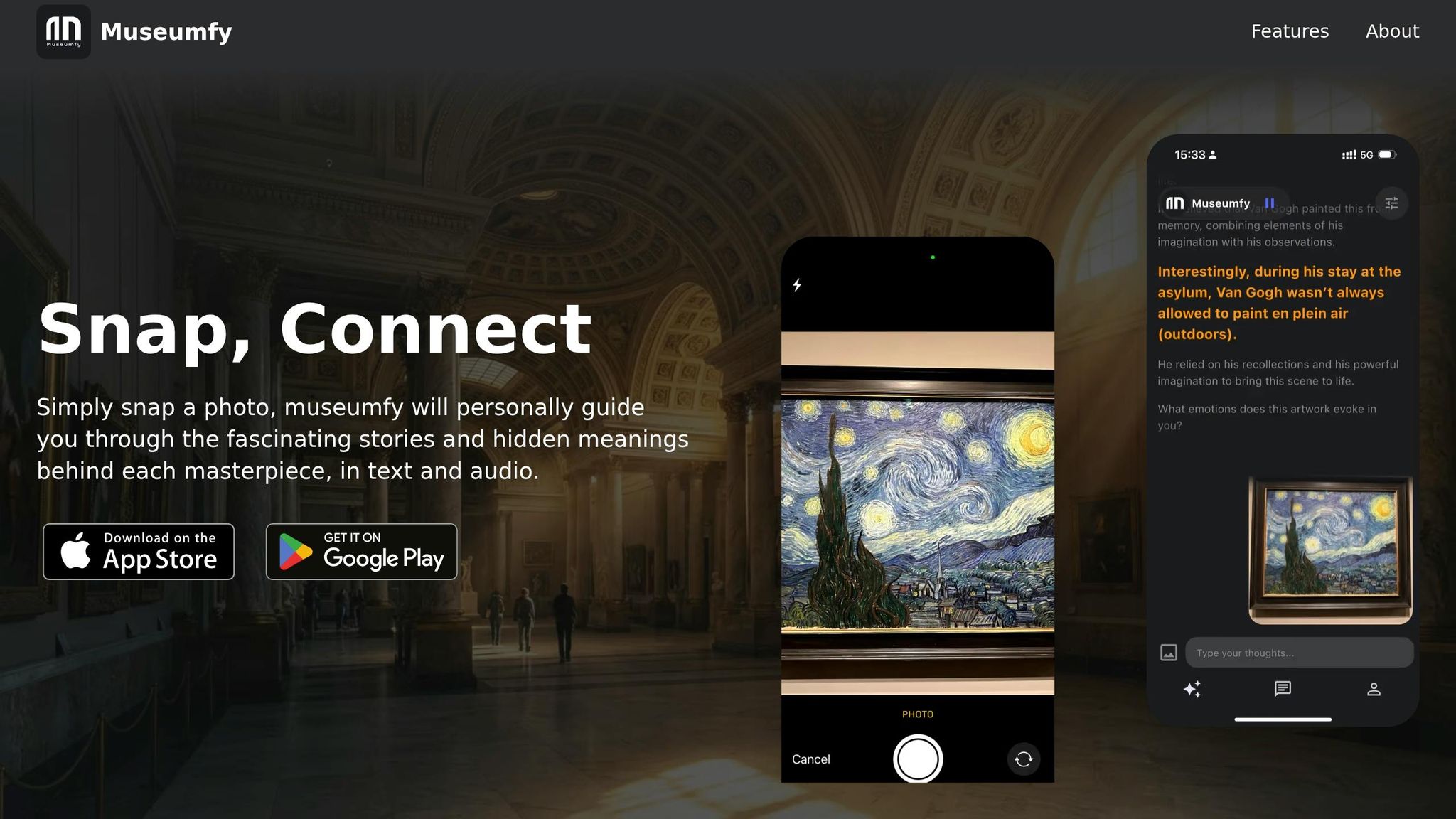
Museumfy showcases how AI-driven tools can make museum visits more engaging and personal. By integrating photo recognition, multilingual support, and adaptive learning, Museumfy transforms a typical museum trip into an interactive and tailored experience. It brings art to life in a way that resonates with each visitor’s interests.
Key Features of Museumfy
Museumfy offers a range of features that redefine how visitors interact with art:
- Photo Recognition: Snap a picture of an artwork, and within seconds, Museumfy provides detailed insights about its history, technique, and cultural background. With an impressive 90% accuracy rate, this feature ensures visitors can quickly learn more about the pieces that catch their eye.
- Multilingual Support: Supporting over 20 languages, Museumfy ensures accessibility for international visitors and diverse communities. Whether through text or audio explanations, users can choose how they want to engage with the content. This aligns with the "Bring Your Own Device" model, giving visitors the freedom to explore at their own pace without relying on traditional museum guides.
- Adaptive Learning: Museumfy customizes tours based on individual interests and the time visitors have available. This feature ensures that even in large collections, users can focus on what matters most to them, making their experience more efficient and satisfying.
Impact on Museum Visitors
Museumfy’s features significantly improve the way visitors experience museums. By breaking down accessibility barriers, the platform makes art exploration more inclusive.
For just $9.99 per month, the Premium Plan offers unlimited access to its features, while a Free Plan provides five photo insights per month. This pricing structure ensures flexibility and accessibility for a variety of users.
The object recognition technology allows visitors to explore collections independently, following their own interests and curiosity. This sense of autonomy enhances engagement, helping visitors connect more deeply with artworks that speak to their personal tastes and knowledge levels.
For museums, Museumfy serves as a valuable complement to existing educational programs. It extends their reach to audiences who might otherwise face language or accessibility challenges. By turning smartphones into portable educational tools, Museumfy makes cultural experiences more inclusive and enriching for everyone.
Future Trends in AI and Interactive Art Challenges
Recent advancements in AI have pushed the boundaries of personalized art challenges, and the next generation of technology promises even more immersive experiences. Museums, in particular, are undergoing a transformation, shifting from static displays to dynamic, interactive environments. Companies like OpenAI, DeepSeek, and Gemini are leading the charge with generative AI models capable of real-time, context-aware storytelling. These systems allow visitors to ask questions and receive tailored responses, creating an engaging, conversational atmosphere for museum-goers.
New AI Technologies for Museums
Augmented Reality (AR) and Virtual Reality (VR) are taking center stage in how visitors experience historical artifacts. AR adds digital layers to physical spaces, letting users view artifacts as they might have appeared in their original context or even interact with virtual characters. VR goes a step further by immersing users in fully recreated historical settings, offering an experience that feels like stepping back in time.
Computer vision and machine learning are also making waves in museums. For example, interactive projection mapping uses sensors to create large-scale visuals that respond to visitor movements, transforming gallery walls into dynamic, participatory art pieces. A striking example of AI's capabilities can be seen at the Museum für Naturkunde, where AI analyzed 250,000 insect specimen tags in a fraction of the time it would have taken human researchers.
Meanwhile, 3D scanning and printing are revolutionizing access to fragile artifacts by creating high-quality replicas. These replicas allow for hands-on learning opportunities that wouldn’t be possible with the originals. Some museums have even introduced humanoid robots like "Pepper", which offer personalized tours and answer visitor questions in real-time. These technologies are not only making museum visits more interactive but are also gamifying the experience to keep visitors engaged. As Cuseum highlights:
"AI systems are without a doubt changing how museums think about storytelling" - Cuseum
Such innovations are paving the way for more engaging and interactive art challenges, elevating the visitor experience to new heights.
Applications Beyond Museums
The impact of these advancements isn’t confined to museums. AI is playing a critical role in preserving endangered languages and digitizing historical archives. A notable example is the Vatican's "In Codice Ratio" project, which uses AI to decode ancient, unreadable manuscripts. Educational institutions are also embracing gamification, integrating points, challenges, and rewards to make learning more engaging and effective across a variety of subjects.
Museums are at the forefront of accessibility innovations as well. AI-driven tools are now translating content into underserved languages, such as Navajo and Haitian Creole, in real time. These breakthroughs are being adapted for use in corporate training, virtual tourism, and entertainment, further broadening their reach. However, experts stress the importance of collaboration in these efforts:
"The future of museum storytelling and AI probably lies in collaboration" - Cuseum
Conclusion
AI-powered interactive art is transforming how people engage with museums. From personalized tours tailored to individual interests and schedules to augmented reality (AR) games that turn historical narratives into immersive adventures, these technologies are redefining the museum experience. They’re helping visitors connect with art and history in meaningful and exciting ways.
Take the Smithsonian American Art Museum (SAAM) as an example. In December 2025, the museum showcased how AI-driven personalization and gamification could raise the bar for visitor engagement. Their efforts not only exceeded institutional goals but also achieved higher-than-expected participation and completion rates, along with consistently strong Net Promoter Scores. Randy Griffey, Head Curator at SAAM, summed it up perfectly:
"It begins with looking at the curatorial content and expertise available and then exploring ways for that content to resonate better with a visitor".
These advancements highlight the importance of effective digital platforms. Tools like Museumfy use AI to create personalized and inclusive art experiences. Features like multilingual support, customized photo insights, and affordable access to art and history ensure that language barriers, financial limitations, or a lack of prior knowledge don’t stand in the way of cultural exploration.
By blending advanced technology with human expertise, AI is playing a vital role in preserving culture. From real-time translations for underserved languages to adaptive learning tools that cater to diverse audiences, these innovations amplify the voices of curators and artists. They make art and history accessible to a wider audience than ever before.
As museums adopt these AI-driven tools, they’re evolving from static spaces into lively, interactive hubs where history, creativity, and technology come together to create unforgettable experiences for all.
FAQs
How does AI make museum visits more engaging?
AI is transforming museum visits by making them more tailored and engaging. Tools like Museumfy use AI to deliver personalized, multilingual information about artworks - simply by taking a photo. With features like augmented reality (AR) and virtual reality (VR), visitors can enjoy interactive and immersive experiences. Additionally, AI-powered guides adapt content to match individual preferences and interests. These advancements are reshaping how people connect with art and history, making museums more inclusive and educational for everyone.
Do AI art challenges help people remember what they learn?
AI-powered art challenges and interactive exhibits have proven to increase visitor engagement and improve learning retention. These tools create dynamic and tailored experiences, helping visitors form deeper connections with the material. This personalized approach often results in better recall and understanding of the information presented.
How can AI improve museum accessibility for different visitors?
AI makes museums more accessible by transforming intricate art descriptions into simpler, more engaging narratives that resonate with all visitors. By easing the mental effort required to grasp complex concepts, it allows guests to immerse themselves in the art, enhancing both enjoyment and learning. Tools like Museumfy take this a step further by offering multilingual, personalized explanations, bridging language gaps and creating an inclusive environment where visitors from different backgrounds and expertise levels can fully appreciate the exhibits.