
AI Solutions for Museum Barriers

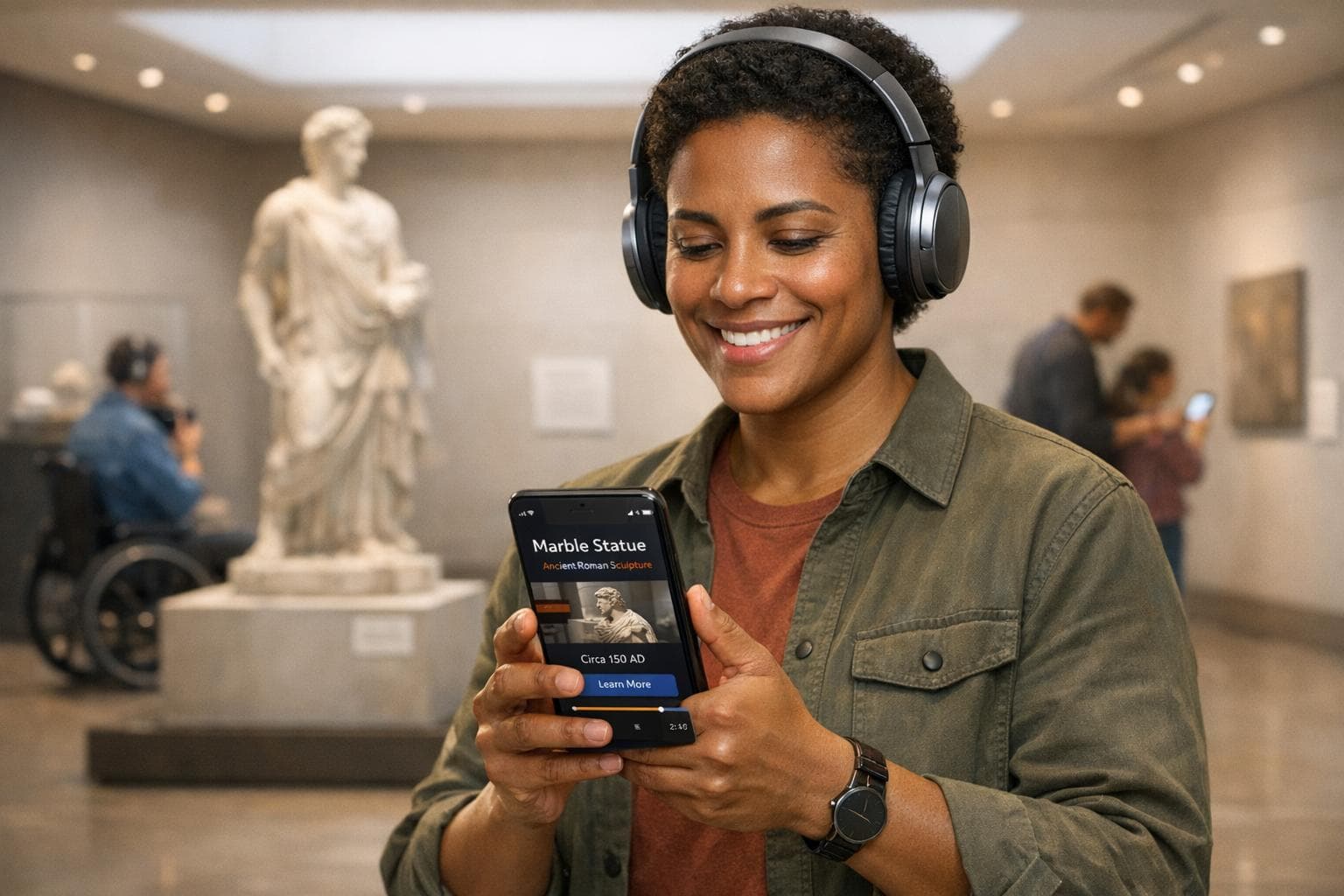
AI Solutions for Museum Barriers
Museums are amazing places to explore art and history, but not everyone can enjoy them fully. Common challenges include high ticket prices, language issues, and experiences that don't meet diverse learning needs. AI is stepping in to fix these problems by making museums more accessible, affordable, and tailored to visitors.
Here’s how AI is helping:
- Lower Costs: AI reduces operational expenses by automating tasks like creating guides and answering visitor questions. This makes museums more budget-friendly.
- Language Support: Tools like Museumfy and Apple's Vision Pro provide multilingual translations, helping non-native speakers understand exhibits better.
- Personalized Experiences: AI adjusts content for different learning styles, disabilities, and interests, ensuring everyone feels included.
- Improved Operations: AI helps manage crowds, optimize exhibit layouts, and enhance accessibility for visitors with disabilities.
AI is transforming museums into spaces where everyone can engage with art and history in ways that suit them best.
AI in Museums | Valorem Visions Season 4 | Episode 6
sbb-itb-e44833b
Common Barriers in Museums Today
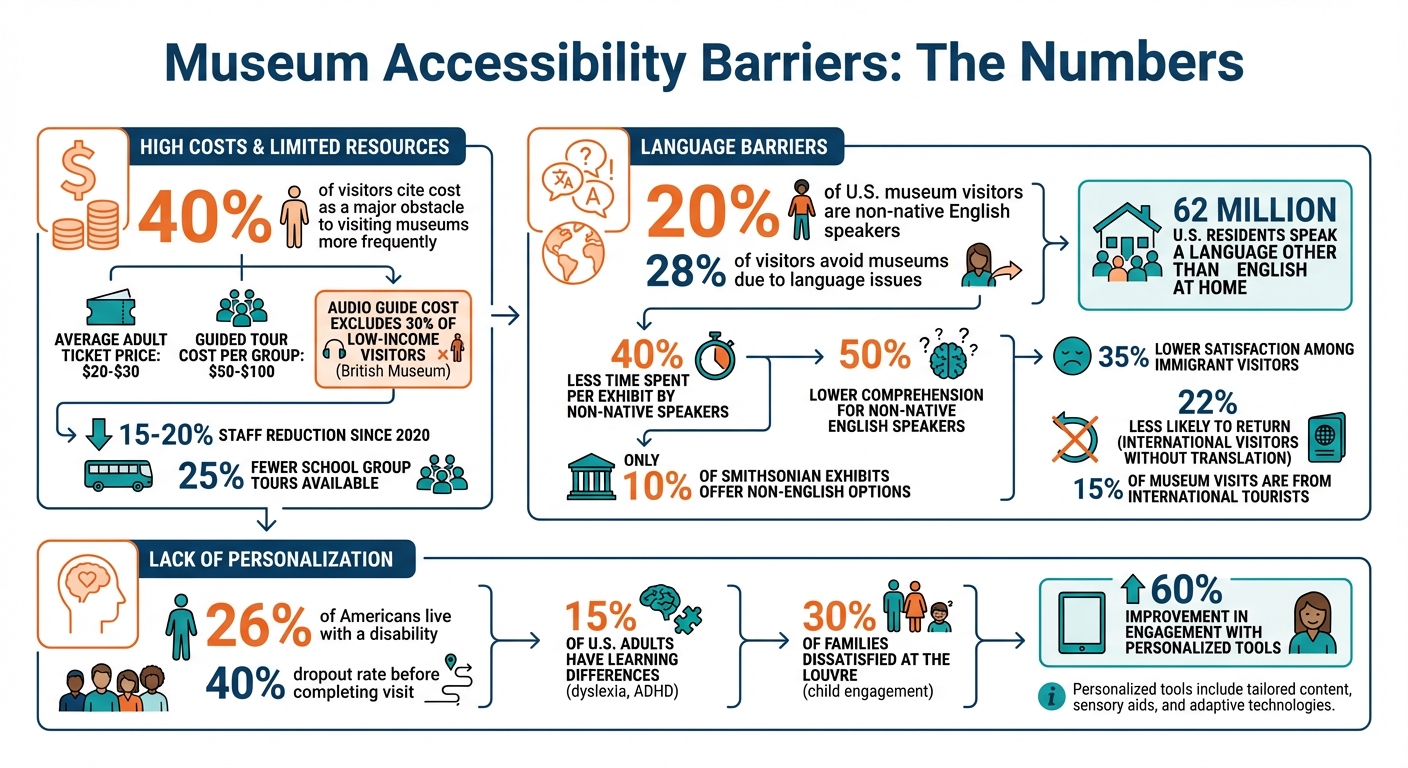
Museum Accessibility Barriers: Key Statistics on Cost, Language, and Personalization Challenges
Museums hold immense value, but several barriers limit their accessibility. These challenges impact families, international visitors, and individuals with diverse learning needs.
High Costs and Limited Resources
Running a museum isn't cheap. Expenses like staffing and artifact preservation often push ticket prices to $20–$30 per adult, with guided tours ranging from $50–$100 per group. This pricing can deter many potential visitors. A 2023 survey revealed that 40% of visitors see cost as a major obstacle to visiting museums more frequently. Even smaller fees, like the $9 cost of audio guides at the British Museum, can exclude up to 30% of low-income visitors.
Staffing shortages further compound the issue. Since 2020, museums have seen a 15–20% reduction in staff, resulting in 25% fewer school group tours. This has led to longer wait times, overcrowded exhibits, and fewer opportunities for personalized interactions - all of which diminish the visitor experience.
Language Barriers
Language differences create another significant challenge for museum-goers. Around 20% of U.S. museum visitors are non-native English speakers, including those who speak Spanish, Mandarin, and other languages. Yet, many exhibits are presented only in English, leaving these visitors at a disadvantage. A 2024 report from the American Alliance of Museums found that 28% of visitors avoid museums due to language-related issues. Non-native speakers spend 40% less time per exhibit and report 50% lower comprehension compared to native English speakers.
The problem is especially apparent at institutions like the Smithsonian, where only 10% of exhibits offer non-English options. This has led to 35% lower satisfaction rates among immigrant visitors. With 62 million U.S. residents speaking a language other than English at home - and international tourists making up 15% of museum visits - addressing language barriers is crucial. Without proper translation, international visitors are 22% less likely to return.
Lack of Personalization
Museum experiences often take a one-size-fits-all approach, which doesn't work for everyone. Standard guides fail to account for varying learning styles, pacing, and interests. For instance, 15% of U.S. adults have learning differences like dyslexia or ADHD, making dense, text-heavy displays difficult to navigate. Additionally, about 26% of Americans live with a disability, and many struggle with rigidly paced presentations, leading to a 40% dropout rate before completing their visit.
Families also face challenges. At the Louvre, 30% of families expressed dissatisfaction with tours that didn’t engage children. Research shows that personalized tools, such as custom apps, can improve engagement by 60%. Without tailored experiences, visitors are less likely to enjoy their time and even less likely to return.
Recognizing these barriers is the first step toward finding solutions that can make museums more accessible and enjoyable for everyone.
How AI Addresses Museum Accessibility Challenges
AI is reshaping how people experience museums by streamlining operations and creating more engaging interactions for visitors. These advancements are making museum visits more affordable, inclusive, and tailored to individual needs.
Affordable Access with AI-Powered Tools
One of AI's biggest contributions is cutting costs by automating tasks that once required significant human effort. For instance, the Louvre employs conversational AI guides that handle visitor questions and help navigate exhibitions, reducing the reliance on multiple human tour guides. Similarly, Microsoft's Azure AI created audio descriptions for the Rijksmuseum's collection in just a few hours.
Museumfy, a platform powered by AI, offers automated text and audio guides in over 20 languages for just $9.99 per month. This eliminates the need for expensive printed materials and multilingual staff, making it easier for even small museums to deliver engaging and high-quality visitor experiences. By lowering these operational costs, AI frees up resources that can be used to tackle other accessibility hurdles.
Breaking Language Barriers with Multilingual AI
AI is also bridging language gaps, making exhibits more accessible to non-English-speaking visitors in the U.S. and beyond. For example, the Louvre’s conversational AI guides support multiple languages, allowing international visitors to interact with exhibits effortlessly. The British Museum’s Living Museum project also uses AI assistance to enhance accessibility.
Museumfy enables visitors to snap a photo of an artwork and receive detailed insights and historical context in their preferred language. Apple's Vision Pro takes this a step further with real-time translation and captioning for exhibits, helping visitors navigate linguistic differences with ease. These tools are especially valuable in globally popular destinations, where multilingual support is crucial for an inclusive experience.
Personalized Museum Experiences
AI's ability to personalize experiences is transforming how museums cater to diverse visitor needs. Institutions like the British Museum and MoMA are using machine learning to tailor exhibits and deliver customized content. By analyzing visitor data, AI tools can suggest connections between exhibits or provide content that aligns with individual interests.
For visitors with disabilities, AI offers visual descriptions and adjusts content complexity to match specific needs. Platforms designed with accessibility in mind can also adapt explanations for individuals with learning differences like ADHD or dyslexia. Technologies such as QR codes linked to ChatGPT provide auditory descriptions and navigation aids via smartphones, improving accessibility for those with visual impairments. Unlike traditional "one-size-fits-all" approaches, AI enables museums to offer experiences that are as unique as their visitors.
Improving Museum Operations with AI
AI isn't just about enhancing visitor engagement; it's also transforming how museums operate behind the scenes. By leveraging AI, museums can streamline processes, improve safety, and make their spaces more accessible for everyone.
Crowd Management and Navigation
Managing visitor flow has always been a challenge for museums, but AI-powered systems are stepping in to help. Using 3D sensors and video analytics, museums can monitor real-time visitor movement, identify bottlenecks, and track dwell times without compromising privacy - thanks to image anonymization techniques. These tools provide highly accurate data, enabling smoother crowd management.
AI also helps museums prepare for busy periods by analyzing historical attendance trends. With this information, staff can adjust schedules and plan exhibits more effectively. When certain areas become overcrowded, automated alerts notify staff to take action, ensuring safety compliance and a better overall experience.
As Robert X. Yang, AI Scientist at Remark AI, puts it, "Our video analytics solution empowers museums and other cultural institutions to effectively manage crowds, enhance safety measures, and improve visitor experiences".
Navigation tools powered by AR further enhance the visitor experience by directing guests to less crowded galleries and showcasing underutilized spaces. Heat maps generated by these systems also help museums identify areas with low foot traffic, allowing curators to strategically place high-interest artifacts and balance visitor flow. By combining these innovations, museums create safer, more efficient environments for their guests.
Better Accessibility Infrastructure
AI is also making museums more accessible for visitors with disabilities. Digital maps equipped with proximity-based alerts can guide individuals to quieter areas or notify them about nearby workshops and events. These systems can even connect with building management to adjust lighting, temperature, and climate control based on real-time occupancy, ensuring a more comfortable environment for everyone.
For those with mobility or sensory impairments, AI helps protect both visitors and exhibits. By monitoring high-traffic zones near fragile artifacts, the technology reduces the risk of overcrowding and accidental damage. Additionally, AI optimizes energy use in empty galleries, cutting waste and freeing up resources that can be reinvested in accessibility improvements. This shift to real-time monitoring and automation represents a significant step forward for museum operations.
Angie Judge, CEO of Dexibit, highlights the importance of this transformation: "AI will quickly create a world of the haves and have nots. I hope the museum sector will find itself on the right side of that equation".
The Future of Accessible Museums with AI
AI is reshaping museums into spaces where everyone can feel included, breaking down barriers that have existed for years. This transformation is opening doors to more personalized and engaging experiences for visitors.
Take Museumfy, for example. This tool allows visitors to snap photos of artworks and receive customized, multilingual insights. It's a game-changer for people with different learning preferences, such as those with ADHD or dyslexia. Instead of relying solely on traditional audio guides, visitors can access information in over 20 languages through text or audio, tailored to their needs.
AI’s impact doesn't stop at translation. It’s also enhancing how museum collections are cataloged and accessed. By enriching metadata and using image recognition, AI makes it easier for diverse audiences to search and explore exhibits in ways that suit them best. On top of that, museums are blending AI with technologies like 3D printing to create tactile models, as well as QR codes that provide instant visual descriptions. These innovations ensure that visitors with disabilities can fully engage with exhibits.
Conversations about these advancements are gaining momentum, with events like the Museum AI Summit 2025 (March 26–27) leading the way. As museums continue adopting these technologies, they’re moving closer to creating spaces where personalization, inclusivity, and affordability are standard features. The future of museums is one where cultural heritage is accessible to all.
FAQs
Will AI make museum tickets cheaper?
AI has the potential to lower museum ticket prices by making operations more efficient and introducing flexible pricing strategies. For instance, by automating certain tasks, museums can cut costs, which could translate to cheaper tickets for visitors. On the flip side, AI can also drive prices up by using real-time demand data to adjust ticket rates. Whether prices go up or down largely hinges on how museums decide to use these AI tools.
How does AI handle visitor privacy?
AI prioritizes visitor privacy by implementing strong protections such as transparent data policies, advanced encryption techniques, and secure management of personal information. These measures strike a balance, enabling tailored experiences without compromising the security of sensitive data.
Can AI tools work without Wi-Fi?
Most AI tools rely on an internet connection - like Wi-Fi - for real-time updates, access to cloud services, and data processing. That said, there are AI systems built to function offline, though their capabilities are usually more limited without online access.