
AI in Preserving Audio-Visual History

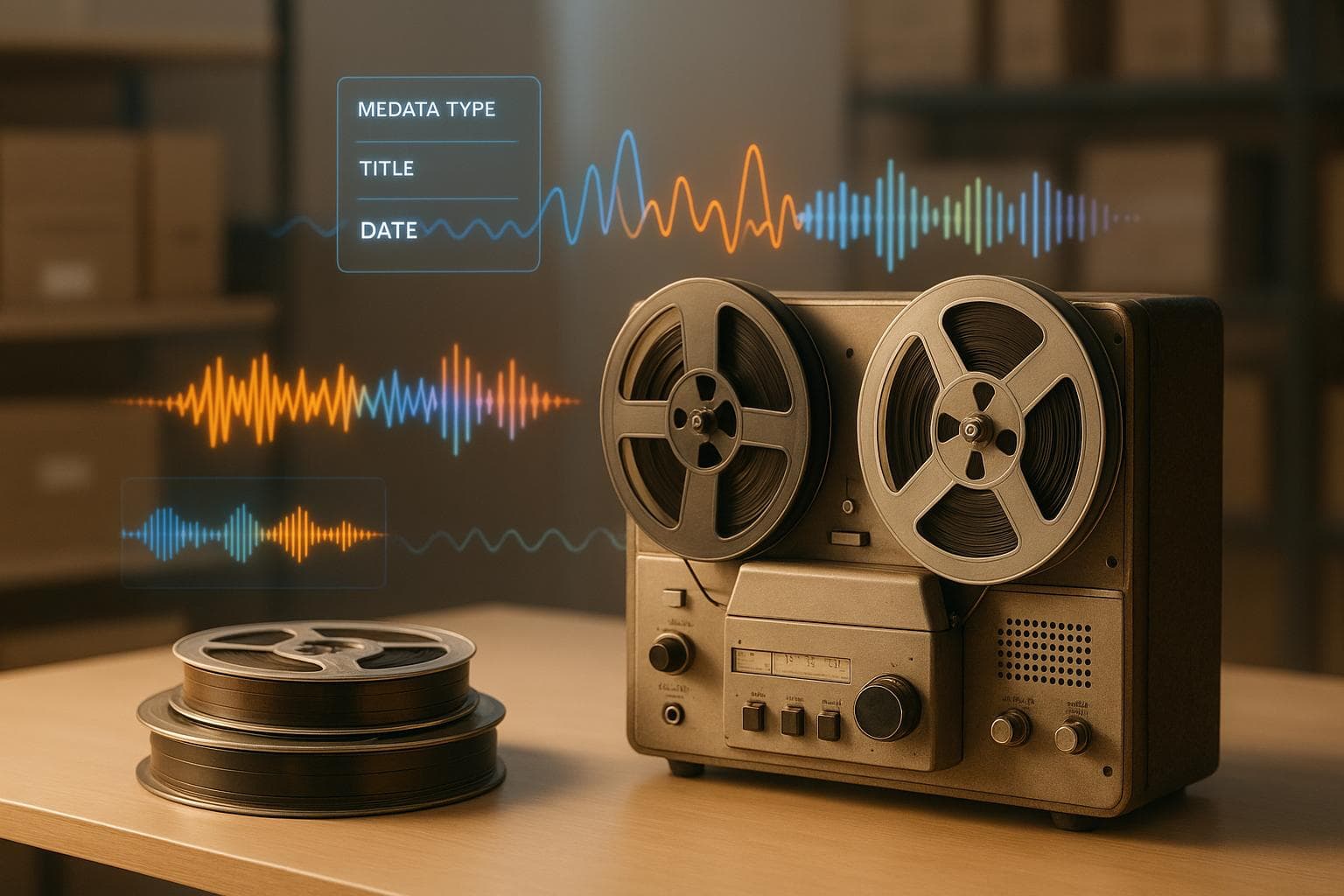
AI in Preserving Audio-Visual History
AI is transforming how we save and access historical audio-visual materials like films, tapes, and recordings. These archives, which degrade over time, hold irreplaceable records of voices, movements, and events. Traditional methods to preserve them are slow and costly, but AI offers faster, more efficient solutions.
Key advancements include:
- Metadata Automation: AI tools can transcribe audio, identify objects in videos, and tag content, making archives searchable and easier to explore.
- Restoration: AI repairs damaged photos, removes noise from audio, and restores faded visuals. For example, projects like the PERCEIVE initiative have digitally revived iconic artworks.
- Accessibility: AI enables real-time translations, subtitles, and audio descriptions, breaking language and accessibility barriers.
- Preservation of Endangered Languages: AI creates digital voice datasets for over 200 Indigenous languages, safeguarding oral traditions.
While AI accelerates preservation, human oversight ensures accuracy, fairness, and ethical use. Challenges like bias in training data, resource limitations, and maintaining historical transparency remain, but ongoing collaboration between archivists and technologists is addressing these issues.
AI is not just preserving history - it’s making it accessible to more people than ever before.
AI in Cultural Heritage Workshop (31 May 2024)
Why Audiovisual Heritage Needs Preservation
Audiovisual materials are deteriorating faster than many realize, and institutions around the globe are in a race against time to save them. Unlike paper documents, which can endure for centuries, magnetic tapes, film reels, and early digital formats face a double threat: the physical materials degrade, and the equipment needed to play them becomes obsolete.
Preservation Challenges
Magnetic media like videotapes and audio cassettes are particularly fragile. They’re prone to oxidation, demagnetization, and physical warping as they age. Film stock, on the other hand, can become brittle and fall victim to "vinegar syndrome", a chemical breakdown that renders it unusable. Environmental factors - temperature swings, high humidity, and light exposure - only speed up this decay.
Digital files aren’t safe either. They face risks like format obsolescence and the degradation of storage media. Regular migration to newer formats is necessary to keep them accessible. Compounding the issue is the disappearance of playback equipment. Without the right technology, entire collections can become inaccessible, creating a divide where only well-funded institutions with specialized tools can access certain materials.
Limited resources make things even harder. Many cultural institutions lack the funding for large-scale digitization, climate-controlled storage, or trained preservation experts. Preservation is often a slow, manual process, forcing institutions to prioritize some items over others. This means many recordings - some of them historically valuable - are at risk of being lost forever. Once materials reach an advanced state of decay, restoration becomes not only expensive but sometimes impossible, requiring specialized tools and expertise.
Historical Value of Audiovisual Archives
These technical and financial challenges threaten more than just physical objects - they jeopardize the stories and cultural narratives embedded in audiovisual records. Unlike text, audiovisual materials capture voices, emotions, and the context of the times, offering a richer understanding of the past.
For example, AI projects are working to preserve over 200 endangered indigenous languages across North America by creating digital voice datasets and transcripts. These recordings safeguard oral traditions, storytelling, and music that would otherwise disappear with the loss of native speakers.
Today, society produces more audiovisual content than ever - through streaming platforms, social media, podcasts, and digital archives. But even "born-digital" content isn’t immune to challenges like format obsolescence, software dependency, and managing files across different storage systems. As audiovisual communication becomes central to how we document the world, future historians will rely heavily on these materials to understand the 21st century.
Global initiatives like the World Day for Audiovisual Heritage, observed annually on October 27th, emphasize the importance of preserving these materials. Programs such as Bangladesh’s effort to spotlight rare and historically significant films highlight how closely audiovisual records are tied to national identity. Other projects, like PERCEIVE, which digitally restored faded colors in historical recordings and artworks, demonstrate the cultural value of these archives.
The loss of audiovisual materials would leave a significant gap in the historical record, affecting academic research, cultural identity, and the preservation of knowledge for future generations. Accessibility is another pressing issue. For instance, over 70 million people worldwide use sign languages, yet many museums and archives lack sufficient accessible audiovisual content. On the bright side, innovative solutions are emerging. The Smithsonian, for example, has developed an AI system that generates real-time audio descriptions for exhibits, making preserved heritage more inclusive and accessible to a diverse audience.
AI for Metadata and Cataloging
Manually cataloging audiovisual collections is an incredibly time-consuming process. A single hour of video might demand several hours of meticulous description and tagging. For organizations managing thousands - or even millions - of items, this approach creates a massive bottleneck. And with the added pressure of dealing with decaying materials and outdated formats, automation becomes not just helpful but absolutely necessary. AI is stepping in to transform this process, making it possible to generate searchable metadata on a scale and at a speed that manual efforts could never achieve. These advancements open the door to AI tools capable of tackling the detailed work of metadata creation.
The National Archives Director has outlined a vision for 2025, highlighting how developments in machine learning, natural language processing (NLP), and computer vision have made AI tools more sophisticated and accessible than ever before.
Automated Metadata Generation
AI leverages a mix of technologies to generate metadata by analyzing audiovisual content. For example, speech-to-text algorithms can automatically transcribe spoken dialogue from videos and audio recordings, turning it into searchable text. Meanwhile, computer vision identifies and tags people, objects, and scenes in photos and video frames. When paired with NLP, these systems can extract themes and generate a deeper understanding of the material. Machine learning models take it further by classifying scenes, detecting transitions, and spotting visual patterns, all while assigning descriptive tags. Together, these tools help create detailed datasets from analog records that were previously difficult to access, significantly improving how collections can be discovered and explored.
In 2023, the Museum of Art & History in Geneva introduced an AI system that generates bilingual audio guides for its exhibits. Visitors using a smartphone app receive real-time descriptions in French or English, complete with historical context pulled directly from the museum's database.
The efficiency of AI systems is game-changing. Unlike humans, AI can work around the clock, processing materials at a speed manual efforts can’t match. This automation allows archivists to shift their focus to more complex tasks, like conducting in-depth research or ensuring the quality of metadata. Even organizations with smaller budgets can now access advanced cataloging tools, making comprehensive metadata creation more achievable than ever. These systems also set the stage for advanced pattern recognition across collections.
Better Search Through Pattern Recognition
AI doesn’t just stop at creating metadata - it’s also adept at finding connections and patterns within massive collections. This capability allows AI to identify recurring visual themes, group materials from specific time periods, and link related recordings that offer different perspectives on the same topic.
Multi-modal AI systems take this a step further by enabling searches across text, images, and audio with a single query. For instance, a researcher looking for "civil rights speeches 1960s" could uncover relevant recordings, videos, and photographs - all identified through automated analysis rather than manual tagging. This ability to draw thematic links opens up new avenues for discovery that traditional methods would struggle to achieve.
To maximize the usefulness of AI-generated metadata, standardizing it according to established archival conventions is key. This ensures that metadata can be shared and integrated across institutions, supporting federated search systems that let researchers query multiple collections at once. Such systems help make cultural heritage materials more accessible to a broader audience.
Accuracy, however, remains a critical consideration. The training data used for AI systems and ongoing human oversight play a central role in maintaining reliability. Archivists, subject matter experts, and consultants often review AI-generated metadata to ensure it captures important contextual and cultural details. This hybrid approach blends AI’s efficiency with human expertise, preserving the integrity of historically and culturally significant materials.
AI Restoration and Quality Improvement
AI is doing more than just organizing and cataloging archives - it’s breathing new life into damaged historical materials. Over time, recordings and visual media can suffer from wear and tear: scratches on film, static in audio, faded colors, or even missing sections. Where traditional restoration methods could take months for a single item, AI now steps in to analyze intact patterns and repair damaged areas quickly and efficiently. This technology transforms once-irreparable materials into accessible, high-quality records, extending their legacy.
Audio and Visual Quality Restoration
AI-powered tools are revolutionizing the restoration of historical audio. Machine learning algorithms can clean up background noise, clicks, and static, bringing clarity to recordings that have deteriorated over decades. This is particularly significant for preserving oral histories, historical speeches, and recordings in endangered languages, where the original quality is often poor or has degraded over time.
On the visual side, AI technologies like computer vision and GANs (Generative Adversarial Networks) are used to digitally repair damaged documents, faded photographs, and corrupted visuals. These systems analyze existing data to reconstruct missing or degraded areas. A notable example comes from 2024, when researchers used machine learning to repair cracks and missing sections in ancient Egyptian tomb paintings. This work even recreated lost hieroglyphics, offering scholars new insights into historical narratives.
AI also excels at creating ultra-detailed 3D models of artifacts. Using photogrammetry and neural networks, thousands of images are integrated to reconstruct fragile or incomplete objects. This approach is invaluable for artifacts too delicate to handle or those with missing pieces.
A standout example of large-scale AI restoration is the PERCEIVE initiative, launched in 2023 with support from the EU. This project focuses on digitally restoring faded colors in famous artworks across 12 museums, including Edvard Munch's "The Scream" and frescoes in Naples. Researchers at the MUNCH Museum in Oslo even developed the "Scream Time Machine", a program that allows visitors to see Munch's 1893 masterpiece in its original vibrant colors and simulate future aging effects. The AI toolkit used in this initiative reconstructs pigments on paintings, textiles, and paper by analyzing data on the materials and environmental exposure. Importantly, these digital restorations are clearly labeled as reconstructions, ensuring viewers understand they are interpretations, not the original works.
Colorization and Format Updates
AI doesn’t just stop at restoration - it also revitalizes visual media by adding color and updating formats for modern audiences.
AI colorization tools analyze black-and-white photographs and videos, adding color based on patterns learned from historical references. Neural networks trained on extensive datasets of colored images can accurately interpret lighting, textures, and material properties, creating colorized versions of grayscale materials. These colorized visuals offer a more immersive way to experience historical events.
While colorized media can make historical content more relatable and engaging, transparency is key. AI-generated colorizations must always be clearly identified as reconstructions, ensuring viewers understand they’re seeing an interpretation rather than the original artifact.
These advancements in restoration and colorization are paving the way for a more accessible and engaging approach to preserving digital heritage. By combining speed with precision, AI ensures that history remains vivid and meaningful for future generations.
sbb-itb-e44833b
Ethical Concerns in AI Heritage Preservation
AI has brought remarkable capabilities to the preservation of audiovisual history, particularly in restoration and cataloging. However, its use raises ethical questions about maintaining the authenticity of historical materials. For example, while AI can fill in missing hieroglyphics or restore faded colors, it also blurs the line between what is original and what is digitally reconstructed. This creates a pressing need for accuracy, transparency, and thoughtful representation when using AI in heritage preservation.
Maintaining Accuracy and Transparency
One of the biggest challenges is ensuring that AI-generated restorations are easily distinguishable from original historical content. When algorithms fill in gaps in damaged photographs, reconstruct audio, or colorize black-and-white footage, the results may look flawless - but they are interpretations rather than authentic artifacts. If these distinctions are unclear, the credibility of archives could be undermined, potentially spreading misinformation. For example, AI-assisted colorization of historical photographs or the reconstruction of ancient artwork must always be labeled as digital restorations, not as original pieces.
Projects like the PERCEIVE initiative address this by clearly labeling all AI-generated reconstructions, ensuring transparency about the technology's role. In 2024, researchers at Egyptian heritage institutions used machine learning to repair cracks in ancient tomb paintings, recreating missing hieroglyphics. These efforts were documented as digital restorations to aid scholarly understanding, not as authentic historical artifacts.
Proper documentation is key to maintaining archival integrity. Institutions should meticulously record every AI intervention, noting details such as the algorithms used, parameters applied, and specific modifications made. Implementing version control systems allows both the original and AI-enhanced versions to be preserved, enabling future researchers to revisit and analyze the materials as technology evolves.
Respecting Different Perspectives
AI must also contend with cultural biases present in its training data. For instance, datasets that overrepresent certain narratives can lead to biased interpretations of archival materials, applying perspectives that may not align with the original cultural context. An AI system trained on skewed historical data might tag images or videos with descriptors that reflect outdated or prejudiced views, influencing how future researchers understand these materials.
Efforts are underway to address this issue. By 2025, an initiative aims to develop AI models for over 200 endangered Indigenous languages across North America, creating voice datasets and transcripts to preserve these languages. To ensure the accuracy and authenticity of such projects, it is crucial to involve Indigenous communities in the design and validation of these AI systems. Their input helps ensure that the technology respects and accurately represents their heritage.
Human oversight remains essential. Experts should validate AI-generated metadata, especially for culturally sensitive materials, to ensure accuracy and fairness. Metadata standards should clearly document how AI-generated tags were created, offering transparency into the process. Regular audits can help identify and correct systematic biases, such as disparities in how individuals are described based on visible characteristics. Additionally, maintaining alternative metadata crafted by community members and subject matter experts provides researchers with diverse perspectives on the same materials.
Striking a balance between engaging public interest and maintaining scholarly rigor is vital. AI enhancements like colorization or 3D reconstructions can make history more accessible and appealing to general audiences, but historical accuracy must take precedence over aesthetics. A tiered approach works best: provide original, unaltered materials for academic research, and offer clearly labeled enhanced versions for public engagement. Educational materials should accompany these reconstructions, explaining the AI process and acknowledging any uncertainties in the results.
Platforms such as Museumfy illustrate how AI can enhance accessibility while maintaining high standards of accuracy, boasting a 90% accuracy rate in its interpretations.
Responsible use of AI also requires robust institutional review processes. Ethics committees - comprising archivists, technologists, subject matter experts, community representatives, and ethicists - should review AI applications before they are implemented. These committees can evaluate the necessity of AI interventions, identify potential biases, and ensure that proper documentation and transparency measures are in place. These discussions are part of a broader effort within the preservation community to balance technological advancements with the responsibility of safeguarding historical authenticity.
AI for Public Access to Audiovisual Heritage
AI is reshaping how we access and interact with history, making once-exclusive archives available to anyone with an internet connection. From breaking down language barriers to delivering personalized experiences, AI-powered tools are transforming the way we engage with audiovisual heritage. These technologies are not just preserving the past but making it accessible to everyone, everywhere.
Multilingual and Personalized Content
Historically, language barriers have limited who could fully engage with audiovisual heritage. AI translation tools are now changing that. Major platforms currently support over 100 languages using neural machine translation. By 2025, experts predict that 30% of virtual reality platforms, including virtual museum tours, will feature built-in AI speech translation, enabling real-time multilingual communication. This means visitors can view subtitled videos, listen to AI-generated audio guides, or read exhibit descriptions in their preferred language - all in real time.
But AI doesn’t stop at translation; it also personalizes content to suit individual needs. For example, a casual visitor might get a quick, engaging summary of a historical artifact, while a researcher could dive into detailed technical data about its restoration and provenance. Museumfy is a great example of this. Users can snap a photo of an artwork and instantly receive detailed historical and contextual insights in over 20 languages, with a 90% accuracy rate.
AI is also playing a critical role in preserving endangered languages. By 2025, projects are developing AI models for over 200 at-risk Indigenous languages across North America, creating digital voice datasets and transcripts to ensure their survival. For instance, machine learning can document oral storytelling or folk songs, preserving them even as native speakers become scarce. Virtual museums have started incorporating these efforts, allowing users to hear recordings of endangered languages or interact with 3D avatars performing traditional dances, keeping these cultural elements alive in the digital world.
Better User Interaction with Archives
AI is making archives easier to navigate and more engaging for users. Traditional archives often required navigating complex systems and technical jargon, but AI simplifies this with user-friendly interfaces and intelligent search tools. For instance, multi-modal AI searches can process text, images, and audio simultaneously. A researcher searching for "women's suffrage speeches" could instantly access transcripts, photographs, and audio recordings - all from a single query.
Accessibility has also taken a leap forward. In 2025, the British startup Silence Speaks introduced AI-driven sign language avatars that translate exhibit text or audio into British Sign Language in real time. These avatars are trained on regional sign variations and even convey emotional nuances. Similarly, the Smithsonian now uses AI to generate real-time audio descriptions of exhibits, enabling visually impaired visitors to experience details like colors, shapes, and scenes through narration. For those who are hard of hearing, AI can transcribe live lectures or audio tours into accurate subtitles instantly.
AI is also revolutionizing storytelling. Tools like ReelMind.ai can transform text and photographs into dynamic videos. These tools ensure consistency in visuals, even when using historical photographs, creating cohesive and compelling narratives. This technology enables museums to share diverse interpretations of history without requiring expensive filmmaking equipment or expertise, broadening public engagement with the past.
With these advancements, museums can now offer virtual tours where visitors explore collections in their native language, receive personalized recommendations, and interact with artifacts through augmented reality. While AI enhances access and engagement, it works alongside archivists and curators, amplifying their expertise and passion to connect with a global audience. Together, they’re bringing history to life in ways that were once unimaginable.
Current Limitations and Future Development
Despite impressive advancements, AI systems still face notable challenges, particularly when it comes to preserving and restoring audiovisual history. Understanding these limitations is critical to ensuring reliable and accurate restorations.
Current AI Limitations
AI technology struggles with several technical and contextual issues when dealing with historical materials. For instance, machine learning often falters when the source material is too degraded to provide adequate training data.
In audio restoration, AI tools can clean up background noise, clicks, and static from old recordings, but they sometimes introduce new artifacts or unintentionally alter the original sound qualities. While Generative Adversarial Networks (GANs) can create plausible reconstructions, human oversight is still essential to verify and refine the results.
Another challenge lies in handling non-standard formats and overlapping tracks. AI models trained on modern audiovisual content often fail to perform well with older materials, which may have distinct technical specifications, color tones, or recording methods. This mismatch can lead to inconsistent restoration quality.
Bias in training data is a pressing issue. If AI systems are trained on datasets that predominantly represent certain regions, time periods, or cultural groups, they risk perpetuating those biases. For example, automated metadata generation models trained on Western archives may misclassify or inadequately describe materials from African, Indigenous, or Asian collections. This issue is particularly evident in efforts to preserve endangered languages. While AI systems are being developed for over 200 at-risk Indigenous languages across North America, they often require more data than is available.
AI also lacks the nuanced understanding that human archivists bring to the table. While these systems excel at recognizing patterns and processing data, they struggle with regional dialects, period-specific terminology, and cultural references. In visual materials, AI can identify objects and faces but cannot reliably interpret their historical significance or social context without human guidance.
Translation models face similar hurdles. They often falter when dealing with archaic language or regional dialects, risking the loss of subtle cultural meanings. For instance, while AI can transcribe and translate oral traditions, it may fail to capture the emotional undertones and contextual depth that are central to these narratives. AI sign language avatars, though promising, still fall short in conveying the emotional and cultural richness of historical or regional sign language variations.
Standardization is another obstacle. Archives, museums, and cultural institutions often use different metadata standards, file formats, and cataloging systems. AI tools trained on one standard may not work effectively with others, particularly in regions with limited resources for standardization. Additionally, many historical audiovisual materials exist in outdated or proprietary formats, requiring conversion before AI can process them. Without consistent documentation of AI-driven restorations, it becomes difficult to maintain historical transparency.
Finally, limited resources and infrastructure hinder the adoption of AI in preservation. Implementing AI systems requires significant investment in computational power, technical expertise, and funding - resources that many institutions simply don’t have. Training advanced models demands extensive datasets and robust infrastructure, such as reliable internet and secure data storage, which are often unavailable to smaller or underfunded archives. This creates a digital divide, where wealthier institutions benefit from cutting-edge AI tools while others struggle to preserve their collections.
These challenges underscore the need for thoughtful innovation and collaboration to overcome current limitations.
Future Research Opportunities
To address these challenges, researchers are exploring hybrid approaches that combine AI with human expertise. These methods leverage AI for routine tasks - like generating metadata or conducting initial quality checks - while leaving critical decisions about restoration and historical interpretation to skilled professionals. Human review of AI-generated restorations before public release is essential to ensure accuracy and maintain trust.
Collaborative international efforts also show promise. For example, the PERCEIVE project, launched in 2023 with EU support, uses AI to digitally restore faded colors in iconic artworks across 12 European museums, including Edvard Munch's The Scream. Such projects highlight the benefits of sharing datasets, methodologies, and best practices to accelerate progress and reduce costs.
Advancements in transfer learning could further simplify the adoption of AI by allowing models trained on one type of material to adapt to others with minimal retraining. Meanwhile, research into explainable AI (XAI) aims to make restoration processes more transparent, enabling archivists to understand and validate AI decisions. Developing models specifically trained on historical materials, rather than contemporary data, could also improve accuracy for period-specific content.
Investing in open-source AI tools and standardized datasets could democratize access to preservation technologies, reducing costs and fostering collaboration. Training programs to enhance AI literacy among archivists are equally important, ensuring they can effectively oversee and validate AI outputs. Building interdisciplinary teams that include archivists, historians, technologists, and community representatives can help ensure preservation efforts respect diverse perspectives.
Clear ethical guidelines are also vital. Institutions must document AI interventions in preservation processes to maintain transparency and accountability. For example, museums should label AI-generated or reconstructed content to prevent misinformation and maintain trust with audiences.
The future of AI in audiovisual preservation lies in creating tools that enhance the expertise of archivists, curators, and historians. By addressing current limitations through targeted research and collaboration, we can better preserve our audiovisual heritage while honoring its historical and cultural significance.
Conclusion
AI has reshaped how we preserve and share audiovisual history. From the PERCEIVE project's digital restoration of Edvard Munch's The Scream to machine learning tools repairing ancient Egyptian tomb paintings, these technologies are saving cultural artifacts from deterioration.
Beyond restoration, AI is expanding access to heritage. In 2023, Geneva's Museum of Art & History introduced an AI system that instantly provided bilingual audio guides for its exhibits. Similarly, the Smithsonian's AI-driven audio descriptions allow blind visitors to engage with displays in ways that were once impossible. These advancements are breaking down barriers for those previously excluded due to language, disabilities, or location.
However, the partnership between human expertise and AI remains vital for responsible preservation. While AI can process vast amounts of data, identify patterns, and handle repetitive tasks, human archivists bring essential contextual knowledge, cultural insight, and ethical decision-making. This collaboration is especially critical for preserving endangered cultural heritage. For instance, as of 2025, efforts are underway to develop AI models for over 200 at-risk Indigenous languages across North America, creating digital voice datasets and transcripts.
Ethical considerations and transparency must guide AI's use in heritage preservation. Institutions should clearly distinguish AI-generated restorations from original materials, ensuring audiences understand what is reconstructed versus authentic. This balance between innovation and cultural sensitivity is key to maintaining trust and historical accuracy.
The integration of AI into audiovisual preservation is about more than technology - it’s about making cultural heritage accessible to wider, more diverse audiences while safeguarding the authenticity that gives these materials their meaning. Platforms like Museumfy highlight this potential by offering personalized, multilingual interactions with art and history. As AI continues to advance, its success in preserving and sharing the audiovisual story of humanity will depend on blending cutting-edge tools with human insight and ethical care.
FAQs
How does AI help overcome challenges like outdated formats and unavailable equipment when preserving audiovisual history?
AI has become an essential tool in tackling the challenges of preserving historical audiovisual materials. One of its standout contributions is its ability to digitally reconstruct and convert outdated formats into modern, easily accessible ones. This ensures that cherished content remains viewable and enjoyable, even as older technologies become obsolete. For instance, AI algorithms can meticulously analyze and restore media that has suffered damage - like scratched film or distorted audio - with impressive accuracy.
On top of that, AI-powered solutions can mimic the functionality of equipment that is no longer available. This allows archivists to recover and digitize content without needing the original playback devices. These advancements play a key role in preserving historical and cultural treasures, ensuring they remain accessible and protected against the wear and tear of time.
What ethical concerns arise when using AI to restore and enhance historical audio-visual materials?
When applying AI to restore historical audio-visual content, several ethical considerations come into play. A major factor is authenticity. AI algorithms, while powerful, can sometimes unintentionally modify or misrepresent the original material. This raises concerns about potentially altering historical accuracy, making it crucial to strike a careful balance between restoration and preserving the original work's integrity.
Another important issue is bias and inclusivity. AI tools are typically trained on specific datasets, which may not adequately reflect the full spectrum of cultural or historical contexts. This limitation can result in unintentional gaps or inaccuracies, particularly when working with materials from underrepresented groups or communities.
Finally, transparency plays a vital role. Institutions and researchers must openly share how AI was utilized during the restoration process. Clear communication fosters trust and ensures accountability, allowing audiences to understand the methods behind the work. By addressing these challenges thoughtfully, AI can serve as an effective tool for preserving history while respecting its original essence and diversity.
How is AI helping preserve endangered languages through audiovisual archives?
AI is stepping in as a powerful tool to help preserve endangered languages by working with historical audio and video archives. It can analyze, restore, and digitize these materials, capturing spoken words, accents, and dialects. This ensures that the unique characteristics of these languages are preserved for future generations.
Using advanced machine learning, AI can also create subtitles, transcriptions, and translations for audiovisual content. This makes these materials easier to access and share, helping to protect linguistic heritage while encouraging a deeper appreciation for the diversity of languages and traditions.