
AI Audio Guides for Artifacts

AI Audio Guides for Artifacts
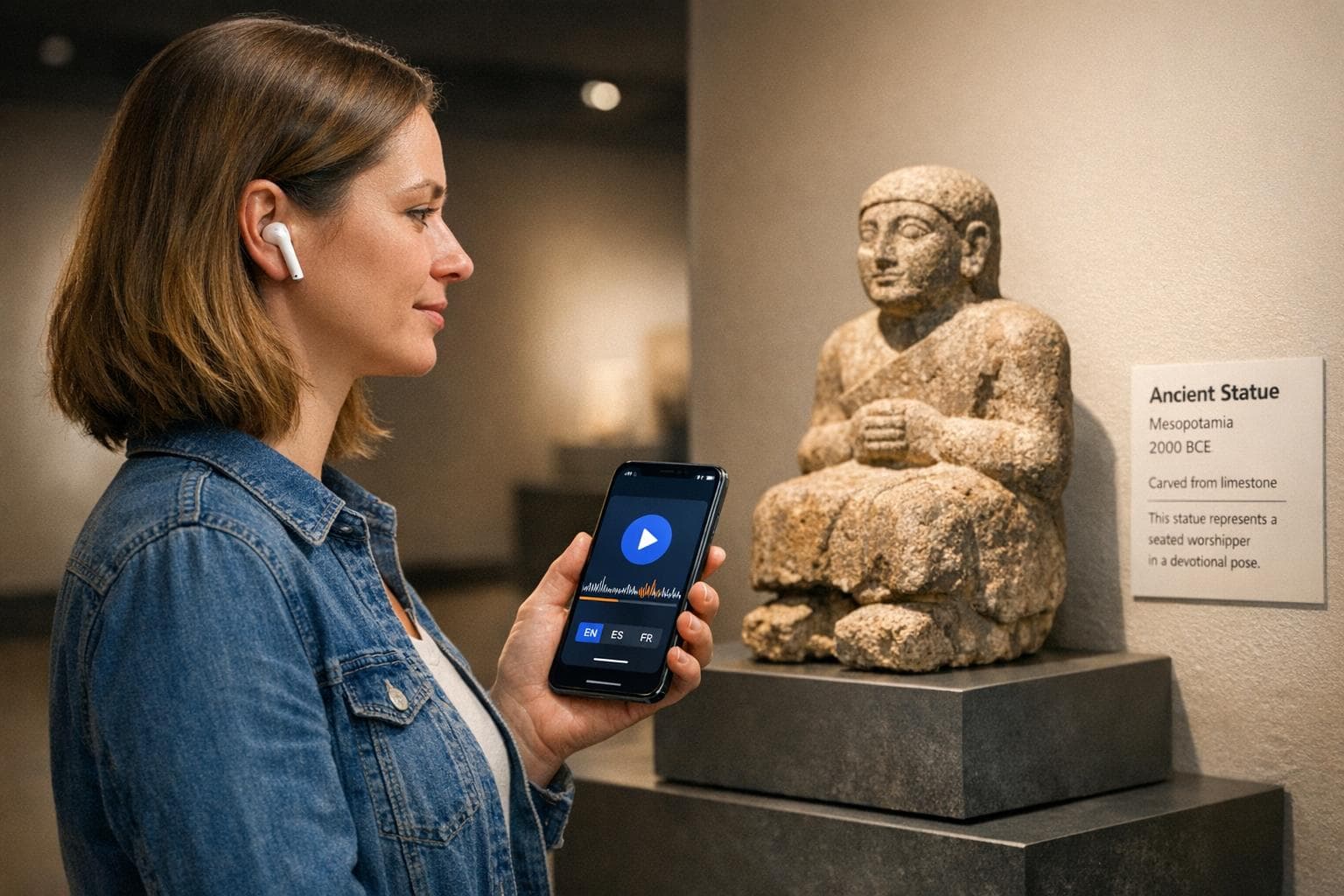
Museums are moving beyond traditional audio guides by using AI-powered systems that deliver personalized, multilingual content directly to visitors' smartphones. This shift saves costs, improves accessibility, and tailors experiences to individual preferences.
Key takeaways:
- Cost Savings: AI reduces production costs by up to 80%, compared to conventional guides that require expensive recording and maintenance.
- Personalization: AI guides adjust based on visitors’ interests, time, and language, offering a tailored experience.
- Language Support: AI supports 30+ languages, far surpassing the 2–5 languages typical of older systems.
- Ease of Updates: AI allows instant updates, while older systems require costly and slow re-recording.
- Visitor-Friendly: AI integrates with smartphones, eliminating the need for clunky rental devices.
Quick Comparison:
| Feature | AI-Powered Guides | Conventional Guides |
|---|---|---|
| Cost | Low | High |
| Updates | Instant | Slow |
| Personalization | High | Low |
| Language Options | 30+ languages | Limited (2–5 languages) |
| Device Requirement | Smartphone (BYOD) | Rental devices |
| Maintenance | Digital-only | Physical upkeep required |
Museums can combine AI’s flexibility with human oversight for the best results, making exhibits accessible, engaging, and easier to manage.
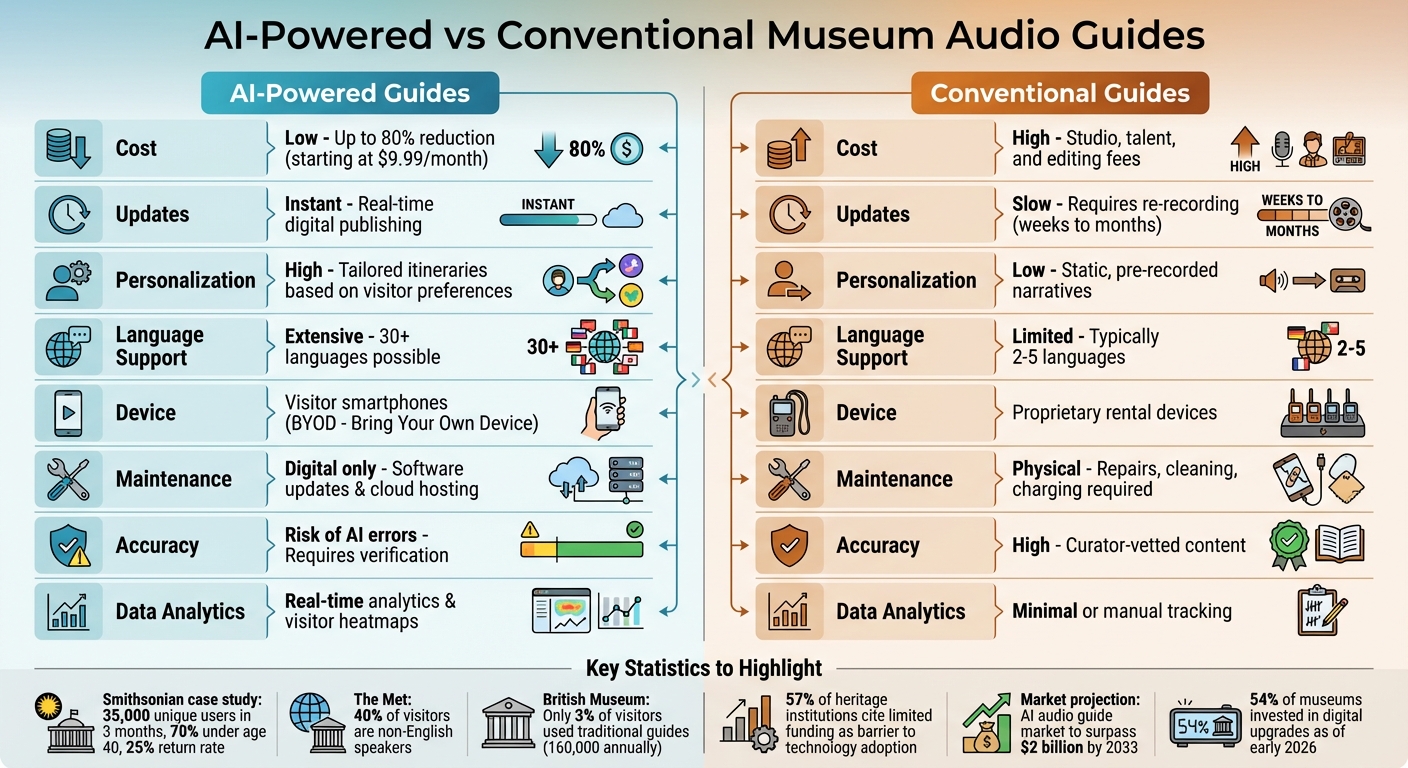
AI-Powered vs Conventional Museum Audio Guides Comparison
1. AI-Powered Audio Guides
Cost
AI-driven audio guides slash production costs by up to 80% compared to traditional methods. Museums no longer need to invest heavily in hiring voice actors, renting studios, or managing extensive editing processes. For example, platforms like Museumfy offer affordable subscription plans starting at just $9.99 per month, providing unlimited access to customizable and multilingual content. Larger institutions can opt for enterprise solutions that eliminate upfront costs through revenue-sharing or subscription-based models. This affordability makes it possible for smaller museums, which previously couldn’t justify the expense, to offer high-quality multilingual guides.
Visitor Experience
AI doesn’t just save money - it transforms how visitors interact with exhibits. Take the Smithsonian American Art Museum as an example. In September 2023, they launched an AI guide that asked visitors about their interests, available time, and preferred language. The results were impressive: 35,000 unique users in just three months, with 70% under age 40 and a 25% return rate. The system also tracked visitor inquiries, revealing a growing interest in Latin American artists. This insight allowed the museum to update its content in real time. Platforms like Museumfy take personalization further by letting visitors snap photos of artifacts to receive tailored explanations instantly - something traditional guides can’t match. This personalized approach strengthens visitor engagement and breaks down communication barriers, as highlighted in the next section.
Multilingual Accessibility
AI audio guides excel at delivering content in dozens of languages in a fraction of the time it takes with traditional methods. At institutions like The Met, where 40% of visitors are non-English speakers, traditional guides often fall short. A recent study found that while 90% of English-speaking visitors rated their experience as "good" or "very good", only 73% of non-English speakers felt the same. Platforms like Museumfy address this gap by offering content in over 20 languages, complete with lifelike narration. This ensures that every visitor, regardless of their native language, feels included and valued.
Content Management
AI also simplifies how museums manage and update their guides. With centralized knowledge graphs, curators can update content instantly, avoiding the delays and costs associated with re-recording audio or requiring visitors to update apps. When exhibits change or new research becomes available, AI systems like Museumfy use Retrieval-Augmented Generation (RAG) to verify content against trusted museum sources. Human editors then review scripts to ensure accuracy in pronunciation and tone, preserving the institution’s authoritative voice while benefiting from AI’s efficiency and adaptability.
sbb-itb-e44833b
2. Conventional Audio Guides
Cost
Traditional audio guides come with steep expenses over a 12–36 month period. Producing these guides requires hiring professional teams, and the day-to-day operations quickly add to the overall cost. Staff are tasked with issuing devices, explaining how to use them, collecting them at the end of the day, conducting inventory checks, and ensuring proper cleaning procedures. On top of that, museums must account for ongoing costs related to charging, storage, and maintenance.
Take the British Museum as an example: in late 2014, it found that only 3% of visitors - around 160,000 people annually - used their traditional audio guides, despite the significant investment required to produce and maintain them.
"An audio guide is not just a 'device' or an 'app'. It's an ongoing service that affects front-of-house workload, hygiene, and content governance." - Pathoura
Updating content on these devices is another costly and time-consuming hurdle. Every update requires re-recording audio and manually uploading it to each individual device, often leading to additional fees.
Visitor Experience
Cost isn’t the only issue - traditional guides often fail to provide a smooth experience for visitors. Users must manually input artifact codes, which can interrupt their immersion in the museum. Research shows that 75% of users end up navigating exhibits in a non-linear way because of the manual code-entry process, rather than following the curated paths. Only 10% of visitors stick to the recommended linear route.
Another challenge is the perception of time. Many visitors avoid using audio guides because they assume the content will take too long to get through - even when they have hours to spend at the museum. A 2014 study at the British Museum, led by Shelley Mannion and involving over 250 participants, found that "Time" was the most common reason for rejecting the guide. Additionally, traditional guides offer standardized content that doesn’t adjust to the varying expertise levels of visitors, leaving both beginners and seasoned enthusiasts unsatisfied.
Multilingual Accessibility
Adding multilingual options to conventional guides is both costly and slow. Museums must hire professional narrators for each language, rent studio space for recording, and manage the logistics of storing multiple language versions on physical devices. The process of writing scripts, obtaining curatorial approval, and professionally recording the content can take weeks or even months, making it difficult to scale quickly.
"Producing comprehensive audio guides, especially multilingual, audio-described, or BSL-interpreted versions, is notoriously costly and time-consuming." - Danna Mulya, Writer, Podego
Budget constraints exacerbate the problem. Over half (57%) of heritage institutions cite limited funding as the main barrier to adopting better technologies. Physical devices also depreciate quickly, creating a "digital divide" where only wealthier institutions can afford advanced multilingual systems. The pandemic further highlighted the drawbacks of shared equipment, with sanitation concerns pushing many museums to reconsider rental devices altogether. This inflexibility stands in stark contrast to AI-driven tools that can update language options instantly.
Content Management
Updating traditional audio guides is a slow and expensive process. Each change requires re-recording and re-uploading audio files. When exhibits are updated or new research becomes available, the process can take months and often comes with additional vendor fees. This lack of flexibility makes it hard for museums to stay current with academic advancements or adapt based on visitor feedback. Combined with the daily operational costs, these inefficiencies highlight the limitations of conventional systems and the growing need for more adaptable solutions.
Talk to Paintings? How ChatGPT Voice Changes Museum Visits Forever!
Pros and Cons
Looking at the earlier points, here's a breakdown of the strengths and weaknesses of AI-powered audio guides compared to conventional audio guides.
AI-powered guides stand out for their ability to personalize and reduce costs. They can create real-time, tailored itineraries based on a visitor's preferences, time constraints, and language needs - stepping away from the "one-size-fits-all" approach. Plus, they slash production costs by up to 80% and allow for instant content updates. Younger audiences, in particular, appreciate the customized experiences these systems can deliver. That said, AI-generated content isn’t perfect. It can sometimes produce information that sounds credible but is factually incorrect. Additionally, synthetic voices often lack the warmth and subtle cultural details that human narrators naturally provide.
On the other hand, conventional guides excel in reliability and human touch. Their content is carefully curated and professionally recorded, ensuring accuracy and authenticity. These guides offer consistent interpretations that visitors can trust. However, they come with logistical challenges. Managing physical devices for distribution involves maintenance, daily cleaning, charging, and repairs. Updating content is also a slow and costly process, as it requires re-recording - especially when adding support for more languages.
Here’s a comparison table summarizing the key differences:
| Feature | AI-Powered Audio Guides | Conventional Audio Guides |
|---|---|---|
| Production Cost | Low (up to 80% reduction) | High (studio, talent, editing fees) |
| Content Updates | Instant (real-time digital publishing) | Slow (requires re-recording) |
| Personalization | High (tailored itineraries) | Low (static, pre-recorded narratives) |
| Language Support | Extensive (30+ languages possible) | Limited (usually 2–5 languages) |
| Hardware Requirements | Visitor smartphones (BYOD) | Proprietary rental devices |
| Maintenance | Digital (software updates, cloud hosting) | Physical (repairs, cleaning, charging) |
| Accuracy | Risk of plausible but inaccurate content; needs verification | High (curator-vetted content) |
| Visitor Data | Real-time analytics, heatmaps | Minimal or manual tracking |
The choice between these systems depends on what a museum values most. For institutions looking to scale quickly and offer multilingual support, AI-powered solutions could be the way to go. Meanwhile, museums focused on maintaining curatorial control and delivering authentic narration might lean toward conventional guides - or even a hybrid option that merges AI’s efficiency with human oversight. Both approaches influence how museums enhance visitor experiences and streamline operations through technology.
Conclusion
Deciding between AI-powered and traditional audio guides comes down to matching the technology to your museum's specific goals. AI guides shine when quick scalability, multilingual support, or frequent content updates - like those needed for temporary exhibits - are priorities. They also provide a cost-efficient option for institutions working with tight budgets. On the other hand, conventional guides excel in preserving curatorial expertise and emotional resonance, making them a great fit for permanent collections or prestigious exhibits.
For museums exploring AI, a hybrid approach offers a smart middle ground. AI can help expand language options and tailor visitor experiences, while human oversight ensures accuracy and sensitivity to cultural details. For example, the Smithsonian American Art Museum successfully used an AI-powered guide to boost visitor engagement.
Ease of access is another key factor. Progressive Web Applications (PWAs) deployed via QR codes can simplify the visitor experience by eliminating the need for app downloads. The Leif Eiriksson Center used this strategy to enable instant updates for seasonal exhibits, avoiding delays tied to app store approvals. This approach lowers barriers for casual visitors, ensuring smooth access to content.
Platforms like Museumfy are also paving the way forward. With tools that allow visitors to snap a photo of an artifact and receive detailed explanations in over 20 languages, museums can offer personalized, hardware-free solutions. This method not only meets modern expectations for scalability and personalization but also provides an affordable option for smaller institutions or heritage sites with limited resources.
The numbers back this shift: as of early 2026, 54% of museums have invested in digital upgrades, and the market for AI-generated audio guides is expected to surpass $2 billion by 2033. By integrating AI while maintaining a human touch, museums can cater to tech-savvy audiences without compromising the authenticity and precision that define meaningful museum experiences.
FAQs
How do museums ensure AI audio guides are accurate?
Museums ensure the reliability of AI audio guides by leveraging advanced tools like machine learning and real-time data updates. They rely on verified sources and expert contributions during the development process to guarantee historical and factual accuracy. Regular reviews and updates incorporate the latest discoveries, while feedback from users helps fine-tune the content. These efforts keep the guides both trustworthy and engaging, staying in sync with the latest research.
Will an AI guide work without downloading an app?
AI guides don’t always need an app download to function. Many rely on web-based solutions, such as QR codes or platforms accessible through a browser. This approach lets users dive into the content instantly - no installations required.
What if visitors don’t have a smartphone or internet?
If visitors don't have access to a smartphone or the internet, museums can provide more traditional options like rental audio guides or printed materials. While tools like Museumfy, which use AI to enhance accessibility via personal devices, are becoming popular, these classic alternatives ensure that everyone can still engage with and understand the artifacts.